Tag: awareness

Geography of Awareness

img_7404

Do you see these “markings” on the back of the fern’s leaves?  In fact, these patterns are spores.  Each one is a potential fern.  The ferns carry their fertility in each and every leaf.  If you are interested in joining a spore exchange group (not kidding), then you might want to look into membership in the Hardy Fern Foundation.  The American Fern Society is over 100 years old and has more than 900 members all over the world.

img_7408

Not only that, but each type of fern has spores that organize in a different pattern.

img_7406

Recently, I have gone on retreat for a few hours a week to the Fern Room at Phipp’s Conservatory in Pittsburgh, Pennsylvania.  Each pilgrimage to this sacred space has brought me to a deeper place of respect for this amazing plant type.  I am also grateful to the amazing Theresa who cares for these plants and seems to have a well of patience for all my questions as well as some of the other horticulturists and care takers who work without fame or glory to keep my fern friends safe and healthy.
img_7419

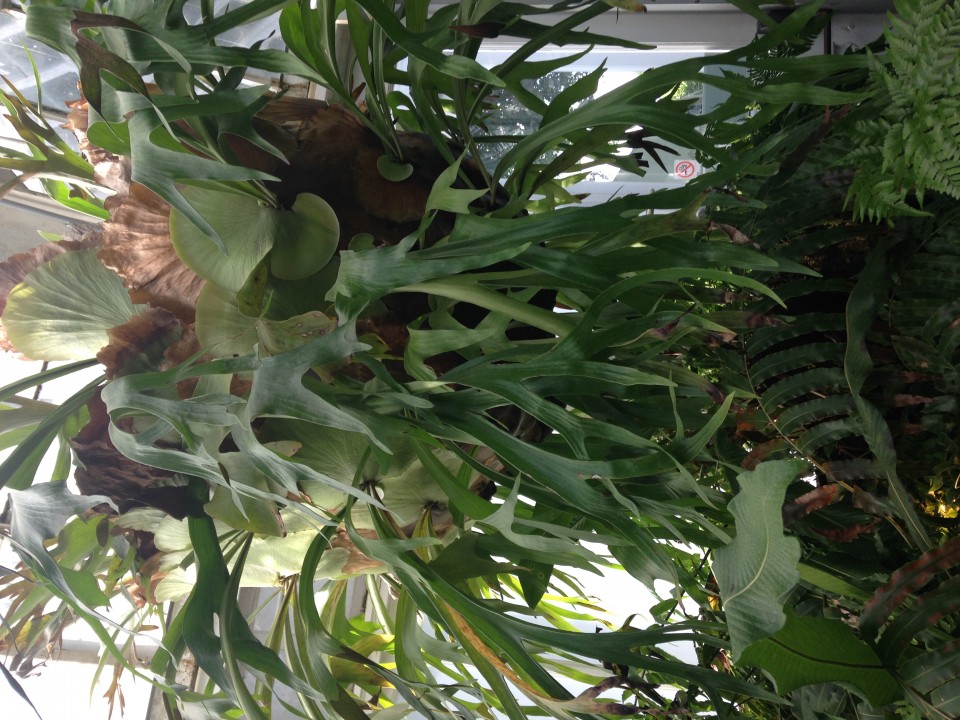
When I sit in this space, filled with ferns, light, air, and space, it makes me feel a lot like I’m being hugged.  The image directly above is a hanging Staghorn and the leaves that drape down almost appear as hands that might pat me on the head while offering me an oatmeal cookie and a glass of milk.  The energy of this space is fertile, abundant, and centered.  It is the embodiment of the heart chakra.  Sometimes, I place my hand in the leaves and allow the energy to roll up my inner arm directly into my heart-space.  Have you ever played with a plant with an exchange of energy?

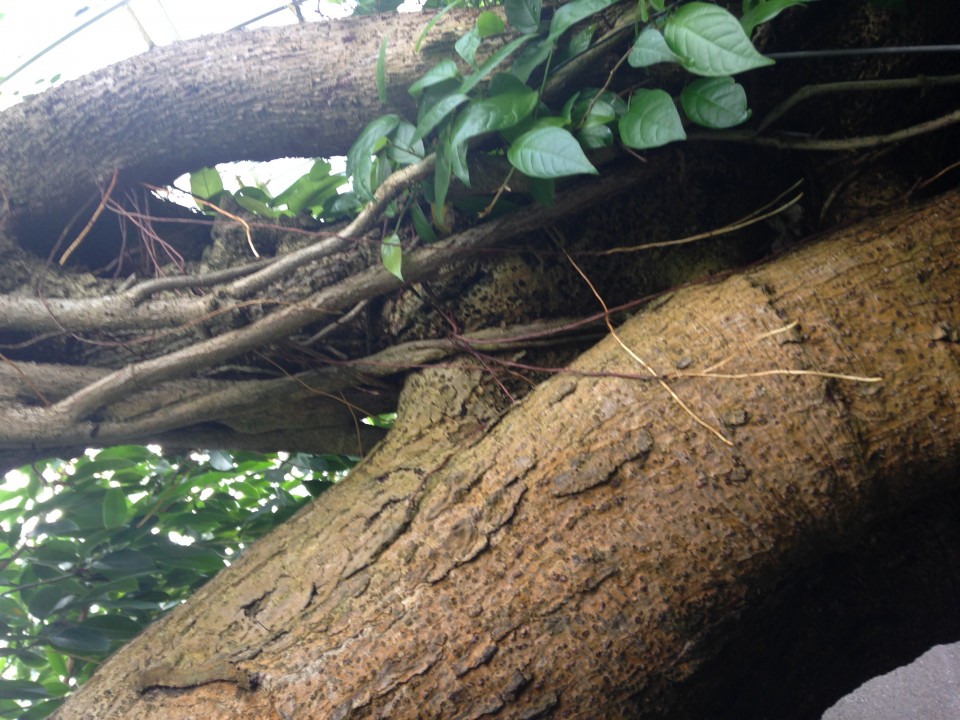
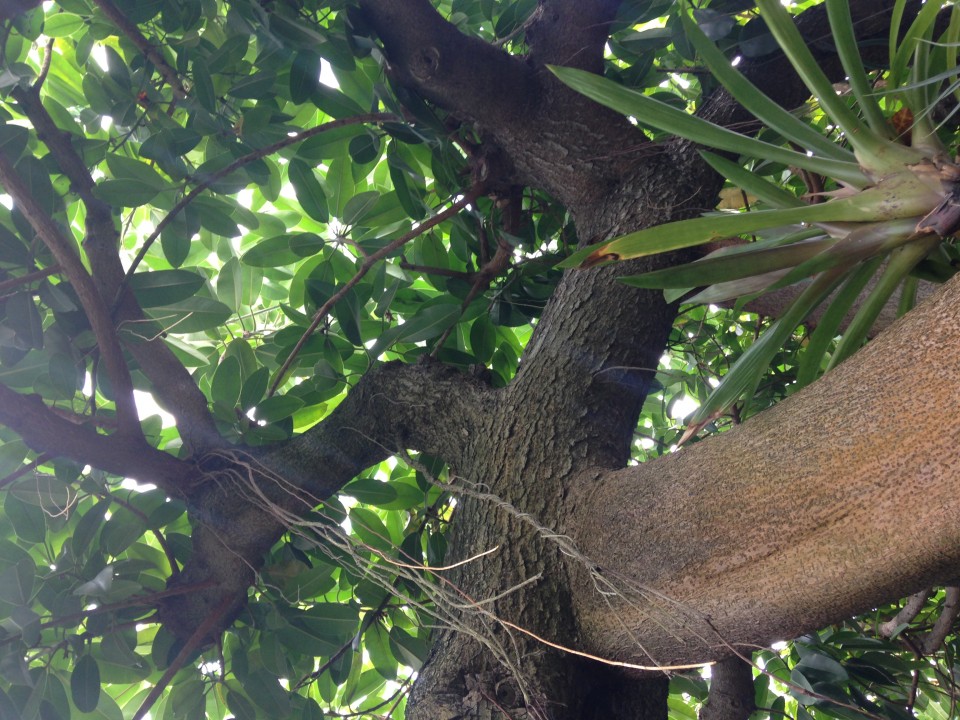
I have a beautiful friend who has some favorite trees that he likes to hug.  While it seems he is an equal opportunity tree hugger, there are some specific trees that he has a long-term relationship with.  When I watch him hug one of his tree friends, trees he has been hugging since he was a child, I can see his whole face and body relax.  What he receives from the tree, he also gives to the tree.  He really is one of the first people I have ever seen exchange energy with a tree.  Sometimes we use the term “green thumb” to mean someone who is good with plants.  Perhaps they can listen to plants and the plants tell them what they need to thrive?  Wouldn’t it be wonderful if we could all learn to listen to the trees?  One of the trees that I am developing a close relationship with is a ficus from Nepal that is in the orchid room at Phipps.  The ficus was added to the collection in 1849.  Go ahead and let that sink in.  I love to press my temple into this grounded being and reach one hand up to press into a higher branch while reaching another down to press into the trunk.
img_7400

How many people have walked beside this ficus newly engaged, with their baby, in their immeasureable grief, on their wedding day, upon the joy of a visit from a beloved friend from afar, to celebrate a holiday or birthday or special occasion? This tree has witnessed it all, but not in silence.  No, the ficus has a deep and grounded vibration.  When I stand close, it absorbs low vibration from me and sends them down deep into the earth and returns high vibrations from it’s wisdom branches that face towards the sun.  Surrounded by fragrant and jewel-toned orchids, the ficus does not fear my worst or suffer from my offering.  I give, I breathe, I receive.  If this isn’t friendship, then what is?
img_7402

When we think about pilgrimage, we think of a destination, but my time with ferns and new friendship with a very special Nepalese ficus have made me wonder if we can also pilgrimage to a new geography of awareness.  In Charles Genoud’s poetic “Gesture of Awareness” (page 116), he suggests that

We may wonder where the body’s awareness is, imagining it’s in the body, but the body’s awareness will only be in the body if we stand outside ourselves trying to figure out where it is.

I can’t tell you how many times I have read Genoud’s book. While I have always had a strong affection for the practice suggested in his teachings, not all of it makes sense.  I have been practicing yoga techniques for enhancing my awareness for 25-years, but this concept above has not been applicable to my practice for all this time.  With my new connection to the vibration of plants and trees, or, rather, with my willingness to open to the vibration of plants and trees, I start to feel a glimmer of understanding.  Awareness is the softening of my friend’s beautiful face when I watch him hug his friend with his arms wide and face and chest warm and open against the bark of the trunk.
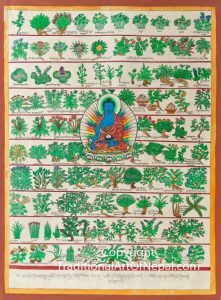
medicine-buddhaNot locating awareness in the physical body allows for a new geography to be explored.  It is the geography of space, perhaps that space that we know to be mapped by mandala. The pilgrimage here, then, is not internal, but it is to an entirely unique geography.  The palms of our hands have an energetic connection to the pericardium, the casing around the heart.  Even if it feels silly, perhaps you want to play?  Just pick a tree that calls out to you.  The more ridiculous this seems, the more you might need this for your soul, your well-being, and a full expression of heart-mind.  Gently place your palm on a place on the tree that calls to you for touch and connection.  Trust your instincts here.  The tree will welcome you.  You know what to do.  Take a few deep breaths into your palm and let the energy of those breaths flow up your arm into your heart space.  The color of the heart chakra is green.  You can do this.  Feel the leafy green tendrils of your heart open to the tree, be fed by the tree, sent laughter and wisdom by the tree.  From your heart to the tree, send it back through your inner arm, wrist and palm of your hand.  You are smiling because this is so important and liberating.  You can’t help yourself.

If you are not free to be out among trees for any reason, then go there in your mind.  Practice wherever you are.  As you practice, the geography of awareness will unfold like a forgotten map to a secret garden that has not been tended to in many, many, years.  This is an important yoga.  This is life.

Written by Sharon Fennimore, a yogini, teacher, and global doula who loves to pilgrimage each and every day to find the sacred in all that is around us in image, experience, and nature.  This post is for Jason, who brought me to the Allegheny National Forest for the first time in my life and, in doing so, changed the geography of my heart-mind forever and my most generous and beloved Aunt Patty who treats me to a membership at Phipps so I can spend as much time as I want with the ferns.


Pounding On An Open Door

“How long will you keep pounding on an open door, begging someone to answer?”  ~Rabia

As soon as I read this quote, I knew it was a question I needed to deeply consider.  It was illuminating to read this because I immediately visualized myself pounding furiously on the open door of life hoping that someone would arrive to help me find my way through.  Yet, there is no need to pound on the door, to kick, scream, beg or demand because the door is already open.  You can walk through, just as you are, right now.

According to the Bhagavad Gita, “There has never been a time when you and I have not existed, nor will there be a time when we will cease to be.  Therefore, play the role you’re meant for right now.”  It’s so hard to accept this in the busy, fast paced life of self-improvement projects that we all live in right now.  My clients all present various anxieties and fears that they are, at the same time, doing too much and missing a certain joyful quality in their lives that they are certain “should” be there and not doing “enough”—to be good partners, good parents, good employees, good citizens of the world.  We are overwhelmed with the sense that something is amiss and that we don’t have a right to just walk through the door and experience the joy that is being alive.  So, we improve ourselves and pound and kick away at the door only to find that there is no bell because there is no one to receive us.

A month or so back, I was attending a Quaker meeting and someone rose and quoted Micah 6:8 from the bible: “He has told you, O man, what is good; And what does the LORD require of you But to do justice, to love kindness, And to walk humbly with your God?”.  Ever since then, the word “kindness” has been coming up for me absolutely everywhere.  Later that same Sunday, I was in the library and the first book I saw was this little, almost pamphlet sized book by Ajahn Brahm called “Kindfulness”.  I checked a book called “Love Kindness” by Barry H. Corey out of the library.  The more I thought about it, the more I realized that cultivating kindness was part of my divine life journey.  Later in the same meeting, someone stood and told a story about how they were really pleased when the principal of their child’s new school asked that all students have respect for one another and their teachers during the orientation, but she thought that what they should really offer one another was kindness.  Kindness, she went on to say, is what is due to all humans, no matter what.  Respect, on the other hand, is earned.  I found this to be profound.  We do not have to earn kindness and we should not ask anyone else to earn kindness from us either.

How are all these things linked?  Well, honestly, I don’t know.  For me, reading is a part of my practice. When these types of ideas present themselves to me through my spiritual life, in my readings, and in my daily life, I try to pay attention.  Even on a surface level, I have to believe that expressing ourselves authentically, walking right through that open door and being gentle and kind to all the other people we meet is a path to great joy for ourselves and everyone that we meet.  How do we get the courage and grace to do this?  Practice.  It takes a lot of practice so that we have compassion for ourselves and others, so that we are aware and so we are mindful of our power to take actions that either improve or decrease the quality of life for everyone we come into contact with.  For today, no matter what your circumstances, offer at least five strangers your brightest and deepest smile.  Tell at least someone you know something that they do that you are truly grateful for or just tell someone that you notice them and all that they do.  Release your narrative in a relationship and just give your special someone a hug and tell them that you are so happy they are there—because, yes, they probably press your buttons and shrunk your favorite sweater and can’t help but burn toast every morning—but what is most important, is their beautiful presence, the light they shine in your life, your house, your family.  I am convinced that offering everything with “kindfulness” will not only profoundly improve my quality of life, but it is a step towards peace in my house, in my community and my world.

Written by Sharon Fennimore, a yogini teaching yoga, meditation and providing integrative health coaching services to women and families with young children based in Pittsburgh, Pennsylvania.  Join my online community Make Room!

No Time to Meditate

I know.  You don’t have time to meditate.  I don’t have time to meditate either.  No one has time to meditate and yet we all have all the time we are ever going to have.  We strive for peace, beauty and happiness, but our hours, days, weeks and then years seem to slip away and we are just as behind on our “to do” lists as we ever were.  While we are busy, it seems we are making things happen, being productive and that we are with purpose.  Resting and calming are considered luxuries that we simply can’t afford.

Our failure to rest makes us prone to panic, anxiety and depression.  Our unhappiness creates mental chaos and we find that even small decisions are hard to make with clarity.  Our sleep is elusive and of poor quality and we can’t remember our last dream.  Our health is “ok”, but we suffer headaches, digestive problems, chronic low back ache, exhaustion and most of the time we can function, but it always feels like just getting by.  Barely.  At times, our little aches and pains tip the scale  towards illness and unease that makes us miss work, school and the activities we enjoy.

Why are we so willing to invest time and energy in creating conditions of unhappiness?  We are terrified of what would happen if we tried to sit for five, ten or even fifteen minutes a day and check in with our bodies, ask our hearts their desire and to feel the breath moving in and out.  Maybe you tried to meditate once and became overwhelmed by the flood of thoughts, ideas and fantasies that came to mind in a powerful and uncontrollable flow?  Maybe you would like to meditate but you don’t know how and you have imagined that you need to sit somewhere quiet for an hour and “clear your mind” and you know that’s impossible for you?

Meditation is available to you and bringing acts of awareness and compassion into your daily life is a radical and transformative act.  You don’t need special clothing, to be able to sit on the floor or to be able to “empty” your mind.  All you need is what you have if you are reading this—your body and your breath.  You don’t need to sit for an hour (wouldn’t THAT be nice!).  You need to make a commitment to practice and there are infinite ways to practice.

I offer an online course called A Mindful Month that invites students to use their senses of taste, balance, touch, and smell to create a sensual state of mindfulness through the day.  The course gives written guidance for twelve 5-minute meditations, four 10-minute audio guides that you can download as MP3 recordings and a bonus 20-minute audio guided deep relaxation.  You can enroll here for INSTANT ACCESS.  The benefits of meditation have been proven, but you must practice to receive those benefits.  This is a perfect introduction to meditation or a lovely inspiration to re-inspire a dedicated meditation practice.

Written by Sharon Fennimore, a birth doula and yoga and meditation instructor based in Pittsburgh, Pennsylvania.  Her Registered Yoga School (RYS™), Yoga Matrika, offers a variety of online yoga teacher training programs.  Private sessions are available on SKYPE wherever you are in the world or in-person in Pittsburgh.

Have a Cuppa for Holiday Tension

Many of my yoga students confide in me that they “can’t meditate.”  In most cases, this is based on a misunderstanding of what meditation is.  In many cases, I inform my students that, in fact, they have been meditating with me for years in our practices together!  Here is a meditation in the form of a tea drinking ritual that everyone can enjoy and an added breathing exercise with aromatherpy for even more emotional balance.

Making an excellent cup of tea takes time.  Use this time to focus on what you are doing.  This ritual starts with the selection of your tea making equipment and mug.  If at all possible, boil fresh water in a kettle on the stove or an electric kettle.  If you must use a microwave, then you must, but for this ritual, it would be most effective if you boiled the water using heat generated from electricity or natural gas so that you can listen to the sound of the water bubbling and boiling.  The type of tea that we will be using for our tension taming ritual is Earl Grey tea.  Use whatever brand and either caffeinated or non-caffeinated, but you want a delicious and full-scented Early Grey.  This type of tea is scented with Bergamot, an essential oil derived from the peel of a citrus fruit.  It is a very special and effective form of aromatherapy that has deeply healing benefits.  This beautiful organic black tea has both the benefits of bergamot and lavender.  I’ve never tried it myself, but it looks delicious!  Please let me know if you do try this tea and let me know how you like it.  If you are looking for a recommendation, I have tried this loose leaf tea and it is absolutely fabulous.  If you prefer tea bags, then I find that Tazo Tea’s Earl Grey is very smooth and has a lovely bergamot aroma.  I like the taste of Twinings, but find that it is light on aroma and perhaps not as affective for this ritual as these others might be.  Avoid a “Lady Grey” tea as they tend to be light versions of Earl Grey.  Again, nothing wrong with Lady Grey teas!  It’s just that we want a full bodied aroma for this ritual.  There are also green tea versions of Earl Grey tea if you prefer lower caffeine and the benefits of green tea as well as caffeine free roobios versions.  Find a great tea that works for your diet and lifestyle considerations.  These links are just suggestions to get you started on your Earl Grey tea selection journey.  These companies are not paying me and I don’t get any benefit when or if you purchase your teas.  Please experiment and find the best tea for your taste.  Enjoyment of your cuppa is a big part of this ritual!

Does it have to be Early Grey tea? 

For this particular ritual, yes, it has to be Earl Grey tea.  This being said, if you don’t like drinking tea or know that you don’t appreciate the flavor or aroma of Earl Grey tea, then don’t torture yourself!  The whole point of this ritual is to decrease tension and increase joy.  Consuming a beverage that you can’t enjoy is going to negate any benefit you might receive from this ritual.  All this means is that this particular ritual is not for you.  I plan on designing many little ritual-based meditations, so search the blog and try another idea that works for you.

This ritual is based on the healing aspects of bergamot—both the oil and the aroma of the oil.  Here are just a few of these benefits:

*relieves tension, anxiety and depression

*the oil itself can be gargled to disinfect the mouth and used for cold sores (especially cold sores that appear when stress arises)

*the oil is excellent for preventing urinary tract infections

*create a spray mist of bergamot to clear stale air (especially effective if you have a tobaco smoke smell to deal with)

This ritual is about dealing with tension and not about perfection.  So, don’t clean your kitchen first or delay the ritual until you run the dishwasher or clear the table of all the present wrapping and junk mail that comes with this time of year.  Just do it.  Personally, I always have to laugh when Yoga Journal or even Martha Stewart Living magazines (both of which I love by the way!) offer advice on how to relieve stress that involve pictures of women who are clearly well-rested, not covered in baby food or bits o’ toddler snacks and live in homes that have been cleaned by a team of others.  The advice usually starts with setting yourself up in a quiet space where you can be left alone in your fabulously new and clean “relaxation practice outfit”………..HA! For this ritual, all you need is a (relatively) clean mug, a way to boil water and about fifteen minutes.  You don’t have to be alone.  You don’t need a special outfit.  So, just push that “stuff” to the side and make it happen!  This being said, as this ritual involves boiling water and a very hot beverage, you may want to wait until your baby or toddler has gone to sleep for a nap or is having quiet time if you are in the care of young children……..you don’t want anyone to get hurt.

Seven Step Cuppa Ritual  for Tension Relief

Step 1: Boil fresh cold water.  While you wait for the water to boil, wash your mug if it isn’t already clean and really experience the process—-the texture of the sponge, the way the warm water feels on your hands, smell the soap.  If your mug is clean, you may want to take this time to wash your hands and perhaps apply some sandalwood, grapefruit, rose or lavender scented lotion.  As the water starts to boil, listen to the qualities of bubbling and the energy of heat acting on the water.  That’s a nice sound.  Perhaps your kettle whistles or your electric kettle has a tiny bell to alert you to the fact that the water has come to a boil?  Really listen.

Step 2: Pour the water over your tea bag or tea leaves either in a cup or a teapot as you wish.  Listen to the sounds.  Feel the weight of the kettle in your hands. Feel the weight of the water shift from the kettle to your mug or pot.  When you are done pouring, place your face a comfortable distance from the rising steam and smell the first aroma of the Earl Grey tea.  Light.  Feel the warmth of the scent when accompanied by steam.  Feel how your breath changes as you inhale the warm and damp air above your cup or teapot. 

Step 3: Wait for it to brew.  I’m not sure how long you would need to brew a green tea or a roobios tea version, but for black tea, no longer than 3-5 minutes or the Earl Grey tea can get bitter.  Set a timer so you don’t have to think about it.  As you wait, take deep breaths into your body and count.  When you exhale, take longer to release the breath than you did to inhale the breath.  If your sinuses are open, try breathing in and out through your nose.  Inhale and slowly, slowly, slowly release the breath. 

Step 4: Make your cup your own.  I like to add a teaspoon of honey and a splash of milk.  Perhaps you prefer lemon?  Do whatever you need to do to make your cup of tea as delicious as possible.

Step 5: Find a place to sit.  Yes, that’s right.  Sit down.  Push all the stuffed animals, socks and cheeze-it crumbs to the side, make room for your butt and then sit.  As you wait for your tea to cool, become aware of your environment.  Listen to the sounds of the room, feel the temperature of the air on your skin, notice the sensation of the parts of your body that are touching your seat and then feel your body, your skin, your feet. 

Step 6: Don’t rush!  Burning your mouth is not pleasant.  When you feel that your tea has cooled to a temperature that is appropriate for you, then take your cup to your mouth and take a sip.  Feel that each warm smallow of tea is bringing liquid calm to every cell in your body.  Be confident that this cup of tea is going to improve your well-being.  Through this ritual and this cup of tea you are giving yourself the greatest gift possible.  The gift of the present moment.

Step 7: After you have finished  your tea, do a gentle scan of your body before you stand up.  Starting with your toes, feel and relax your whole body: feet, legs, belly, low back, middle back, upper back, heart, arms, hands, throat, neck, jaw, face, skull and all the space around you.  Enjoy this feeling.  Your whole body relaxed.  That’s a nice feeling!

Repeat your little ritual as often as you like!  Take the time to make time for the present moment and you will be delighted in how even a minimal investment is returned to you exponentially. 

Bergamot Oil for a Calming and Balancing Pranayama

For this aromatherapy enhanced breathing exercise, you will need to purchase some high quality bergamot oil.  I exclusively recommend and sell Floracopeia essential oils.  They are very high quality and you can count on them to be pure and magical.  If you are a new customer to Floracopeia, then Sharon offers a special 25% off discount to all of her clients.  In order to receive the 25% discount off your entire order, you will follow this link and enter the DISCOUNT CODE: SharonRudyk.  As bergamot oil on the skin increases your chance of experiencing photo-sensitivities, it is best to do this exercise during the winter or in a climate and environment with low light.  If you live in a place with a lot of sun (lucky you!), then please stay out of the sun for at least 30-minutes after you use the bergamot oil on your hands.  Also, you can become sensative to bergamot over time, so switch up your oil use.  You can do this calming pranayama with different aromas and you are not likely to develop sensitivities to bergamot if you rotate your oils (other choices include clary sage, lavender, rose, cammomile or sandalwood).

Before you start the breathing exercise, place a drop of your chosen essential oil with a little carrier oil—–I like almond oil or jojoba oil if you have nut sensitivities—in the palm of your right hand and then rub your hands together.  Come to a seated pose, either in a seated meditation pose on the floor or sitting upright in a chair, and place your left hand in gyana mudra (thumb tip to index finger tip—like giving the OK sign) on your left thigh or anywhere on your left leg that you can comfortably rest it.  You will be using your right hand to alternatively open and close your nostrils.  

Now you will begin Nadi Shodhana Pranayama which is also called Alternate Nostril Breath or Channel Clearing Breath.  Here is a link to full information and instructions on this breathing exercise. As you have applied the essential oil to your right palm, each time that you breathe-in, you will draw the healing properties of the oil into your body and mind.  Continue in this process for 3 or 5 minutes.  Set a timer so that you can relax, focus on the breath and the scent of your palms and not on the time.

Step by Step

Sit in a comfortable asana and make Mrigi Mudra. Beginning pranayama students may have some difficulty holding their raised arm in position for the length of the practice. You can put a bolster across your legs and use it to support your elbow.

Gently close your right nostril with your thumb. Inhale through your left nostril, then close it with your ring-little fingers. Open and exhale slowly through the right nostril.

Keep the right nostril open, inhale, then close it, and open and exhale slowly through the left. This is one cycle. Repeat 3 to 5 times, then release the hand mudra and go back to normal breathing. (NOTE: some yoga schools begin this sequence by first closing the left nostril and inhaling through the right; this order is prescribed in the Hatha Yoga Pradipika, 2.7-10).

Benefits

  • Lowers heart rate and reduces stress and anxiety
  • Said to synchronize the two hemispheres of the brain
  • Said to purify the subtle energy channels (nadis) of the body so the prana flows more easily during pranayama practice

(Instructions and pranayama information all thanks to Yoga Journal)

This little ritual for real people is brought to you by Sharon Rudyk of Sharon Rudyk Yoga based in Squirrel Hill, Pittsburgh, PA 15217.  Sharon is an independent yoga instructor offering mindful yoga and meditation practices, teacher training programs, mindful approaches to pregnancy, childbirth and parenting and classes for all ages and abilities.  If you aren’t in Pittsburgh, Sharon would love to come and visit you and also works with long distance clients using SKYPE technology.  Call Sharon at your convenience for a free consultation (412) 855-5692 and visit Sharon’s website for more information: http://www.sharonrudykyoga.com.

Keep Your Unkind Words to Yourself

Walk silently.

I read this today on a sign indicating appropriate behavior while in the hallway at my son’s elementary school.  When I read it the first time, it made sense to me.  I’m sure that I was trained in the same way and have probably seen this message infinite times in my own elementary school and other institutional experiences and beyond.  But, the more I looked at the sign, the less I was sure of what it meant. In my experience, this means, don’t make noise when you walk in the hall.  But, how do I know this?  Walk silently actually means something very different depending on the context.

There are other messages on other signs.  One of those messages is that students should “Keep their unkind words to themselves.”  Again, upon initial reading, I immediately knew what this meant.  It means that I shouldn’t call anyone a Poopy Head, you know, at least to their face.  But, again, the more I saw this message, the less I was sure of what this really meant.

I was even less sure of what it meant when I happened to walk by the lunch room on my way to my son’s classroom and heard a lunch aid yelling at a student who had walked up to her and asked for help because their hands were full of too much hand sanitizer.  She said, “You took too much soap.  Don’t you have soap in your house?”  Seems that someone hasn’t been reading the signs in the hall!  First of all, it wasn’t soap, it was foaming hand sanitizer.  Second of all, it is not beyond my imagination that this child had never used a dispenser for foaming hand sanitizer before.  Third of all, the implication that perhaps this child did not maintain hygiene at home and therefore was ignorant on how to use the sanitizer at school wasn’t very kind.

So, on the third day of school, this poor child was berated for having too much hand sanitizer on his hands.  I wanted to walk loudly (if you can walk silently, you can also walk loudly!) right into the lunch room with a paper towel and help that child remove the hand sanitizer.  Then, I wanted to use some of the hundreds of unkind words that had immediately come to mind when I watched that Pittsburgh Public School employee talk with complete lack of respect or empathy to that dear child.

What I know is that you can put up all the signs in the world, but the best way to lead these children will be by example.  We must show them that compassion is possible and makes the world a better place to live for everyone.  It feels really good to be compassionate and express empathy and kindness to one another.  We can learn to be loud in our silence and have so many kind thoughts that there is little room for the unkind words.

In our yoga practice on the mat, we first learn awareness.  The first time that we sit on our mat and wait for class to begin, we become aware of the hundreds of thoughts, ideas and feelings that travel across our mind in a single moment.  Some of those thoughts are unkind and we may, at the end of a long day, have myriad unkind words for our family members and colleagues.  But, our practice shows us that it isn’t a sign that should keep us from expressing these unkind words.  Our practice brings us to a space where we notice that our thoughts and feelings are constantly in flux.  Our unkind words in this moment are no more or less true than the kind words that we might have for the very same person on a different day or in different circumstances.  As a matter of fact, after calming the body and mind in a yoga class, we might find that all the unkind words are gone anyway as the intensity of the passion of experience has faded.

What I wish for this lunch aid and all the children and teachers and administrators in my son’s school is awareness.  Awareness that they live and work in community.  Awareness that their feelings and experiences are important, but always changing and shifting.  Awareness that we all make choices in how we express ourselves and that these choices impact other people.

On your mat, the next time that you practice, soften your face and tongue.  Relax the muscles behind your eyes and soften your inner ears.  Feel the expressed and unexpressed unkind words you carry within you.  Free yourself slowly by breathing into the unkind spaces and exhaling the unkind.  Let you body relax and watch the breath as you free yourself slowly of unkind words.  As you practice, catch yourself if you start to think anything but the kindest thoughts about yourself.  Forgive yourself for all the times you used too much soap, forgot to sort the laundry, used the wrong color pen, took the subway in the wrong direction and wore different socks.  Once you feel better, offer some forgiveness to everyone else.

Tonight, in my practice, I’m going to forgive the lunch aid.  It’s a start.

Frozen Food Month

Seriously, did you know that March was Frozen Food Month?  I didn’t know this until I received an e-mail from Giant Eagle supermarkets here in Pittsburgh indicating that there was just one week left to appreciate frozen foods.  From Lean Pockets to Ego waffles to Mint Chocolate Chip Ice Cream (my personal favorite of the frozen edibles), we had a whole month to appreciate frozen foods and I squandered it not realizing my loss.  But, it’s not too late, there’s still a whole week to take advantage of this special time to explore the delights of our freezers.

Did you know what else March is? Women’s History Month.  Yes, women share the glory of this month with frozen foods.  So far, President Obama has not yet made an official Women’s History Month 2011 Proclamation.  When he does, it will be posted here. Now, while we mere citizens have an entire week to honor frozen foods and the ladies we love at the same time by buying them some ice cream, the President only has one more week to come up with an official proclamation on the topic of Women’s History Month 2011.  Might I suggest that he enjoy the convenience of a frozen food while writing?  The thing is that I didn’t know that all of the Presidential Proclamations were available like this.  I have to admit, it’s a rather curious collection.  This month*, President Obama has offered Proclamations on topics ranging from from “Save Your Vision Week” to honoring the 100th Anniversary of the Triangle Shirtwaist Factory Fire to the 150th Anniversary of the Unification of Italy. It seems that when you are President of the United States, remembering your own wedding anniversary is the least of your problems.  So far, nothing yet on either frozen foods or the important contributions of women in the history of the United States.

What does any of this have to do with yoga or meditation?  It has everything to do with yoga!  Yoga and meditation are practices that encourage us to become aware in this moment.  By proclaiming a day, week or month a certain theme, we are suggesting that there are things we appreciate or that we should recognize that we may generally ignore.  This is what we do in our practice as well.  All day long we breathe, but when we practice, we watch the breath.  We see all the qualities of the breath—fast, slow, shallow, deep.  We experience the sensation of each in-breath as an in-breath and each out-breath as an out-breath and we feel our body’s response.  Setting aside some time each day for your yoga and meditation practice is like proclaiming that the next hour is “Sensation of Breath Hour.”  We come to appreciate what we generally take for granted.

Posted by Sharon Rudyk, an independent yoga and meditation instructor in Pittsburgh, Pennsylvania.  You can find out information about classes and teacher training programs with Sharon at https://www.yogamatrika.com/ and prenatal/postnatal programs and support services at http://www.matrikaprenatal.com.

*Wondering what President Obama proclaimed about this special month in March 2010?  Check out the proclamation archives here.

Meditation in Motion

Read more on the benefits of meditation.

Read more on how regular meditation can impact your genetic expression.

Read here on basic instructions for mindfulness meditation.

Meditation in Motion: 4-class Series
Mondays 6:00-7:30 pm, 3/14 through 4/4
Facilitated by: Sharon Rudyk
Cost for 4-class series: $65 (Online Registration HERE)

Research indicates that the benefits of mindful breathing, gentle physical movements and a variety of techniques including visualization and meditation are powerful tools for health and healing. From reversing heart disease to changing the expression of your genes, a regular meditation practice has a significant impact on your quality of life. In this small group series, we will specifically explore a variety of meditation techniques that can be used by anyone regardless of your previous experience with yoga or meditation. We will do some physical movements, but these types of movements are very natural and can be accomplished by any adult regardless of your physical shape or abilities (they can even be done while sitting in a chair!). Relieve stress, relax the body and learn quick and simple ways to improve your quality of life every single day.

Here is a video about walking meditation

Gesture of Awareness

I have recently become acquainted with the most fascinating and inspiring book, Gesture of Awareness: A Radical Approach to Time, Space, and Movement.  The book is authored by Charles Genoud (2006) and published by Wisdom Publications.

The dedication of the book reads “It is over.”  which gives a strong hint to the reader that their experience with time is about to get shook-up and turned on its head.  How can it be over when the reader has just begun?

“But how can it be over before anything has started?  And can anything really start?  To start something     implies it will go on, will end.  That is the movement of time.  But is there truth in this sense of movement?  To start something is to step into time, and to step into time is to step out from reality into an   insubstantial world of images, of language.  Therefore, to start, to go on, to be over–may all be equally illusory. (3).”

I have been finding this radical approach to time to be helpful both in waiting out this month of record snow fall and in how I am viewing my academic pursuits.  It seems that there will never be an end to this snow and the challenges that it creates.  And, on most days, I am not sure that I can recall how I got on this academic wheel and I certainly don’t see an end in sight.  Yet, if there was never a beginning or an end to either this weather or my pursuit of a Ph.D, then I am free to just be here today—-looking out at the beautiful snowscape from my window and reading and writing and thinking.

In the Gesture of Awareness, the exploration is of the way that “physical sensations never depart from the nature of awareness.  The body is the main place of inquiry….  The body knows itself not as this sensation, or as that sensation, but as pure presence.” (11)  When yoga students are asked to become aware of sensation in the body, this is an incredibly challenging request and one that both instructors and students need to respect.  The first challenge is that, in so many cases, we are required to become numb to our bodily sensations or we have been taught that our bodies are shells for the more important things that we do as driven by our brains and the wants and needs that these brains create.  The second, and perhaps greater challenge is that it is so very hard to define precisely what “awareness” is.  How exactly does someone become aware of sensations in their body?  What is used to become aware—the brain, the mind?  And, what exactly is the mind anyway?  Where is it located and how do I use it in my sensation-seeking activities?

Genoud asks us if we are using meditation as a way to simply distract ourselves from life (27).  If so, then he questions the value of a practice that takes us away from life (27): “If meditation takes us away from life, what is the use of meditation? (27).”  Genoud asks if we can be open in our meditation, “Can we be open in our meditation–can we be open as we walk or touch another?  What does it mean to be open?”  (31).

Every page of this beautiful book is a gem and I highly recommend it to meditators, students of yoga, instructors of yoga and meditation and anyone who wishes to be inspired to see the body in a different way.  The ideas are profound, but presented in simple statements and phrases so that the reader can use this text for a lifetime of growth, peace and exploration of the body, soul and time.

Posted by Sharon Fennimore Rudyk, owner and director of the Matrika Wellness Center in Pittsburgh, Pennsylvania http://www.matrikawellnesscenter.com and the community-based yoga studio, Yoga Matrika, also in Pittsburgh, Pennsylvania https://www.yogamatrika.com/.

Find information about purchasing the book here:

http://www.wisdom-books.com/ProductDetail.asp?PID=16150

Another review is here:

“Gesture of Awareness,” by Charles Genoud

Cabin Fever & Yoga in Pittsburgh

There was one very brave student at tonight’s class.  She was new to Yoga Matrika and was curious about what the class title, Mindful Yoga, really meant.  I prattled on about Vajra Yoga and not making a distinction between asana practice and meditation and how we create a moving meditation through our practice……….but during our practice together, I started to question the whole thing entirely. 

You see, that’s the problem with having an answer to everything—-you miss opportunities for reaching a greater understanding.  In this case, I was incredibly inspired by the clarity of this student’s practice and she taught me a lot about mindfulness.  So, thank you dear student, and hope you come back soon!

What I realised is that what I don’t know about mindfulness is a lot.  While there are so very many things that I hope that my Mindful Flow classes mean, the real mindfulness is in the interpretation.  I asked my student to choose an intention for her practice and to anchor that intention with awareness of the breath or awareness of sensation in the body.  As we moved through the Vajra Opening series, I made some slight adjustments and made requests of the student to move in different ways or experiment with various modifications. 

I was delighted to watch as this student’s mind literally moved from place to place in her body and she fully explored each asana.  Thanks to this student and her beautiful practice, I realised that it is possible to see mind.   A great gift to a yoga teacher on a snowy night after a long week of being indoors. 

I received a similar gift through my dear friend and colleague on the teaching team at Yoga Matrika, Kristie Lindblom.  She posted a beautiful entry in her blog about how she is personally experiencing this long week of a storm and nature enforced hibernation.  Again, a new lesson on mindfullness.  By staying present in the moment, Kristie rides out the storm, the cabin fever and the heavy nature of this weather.  Her mindfulness includes all of the wonderful things that are growing, changing, transforming and preparing for birth right under our very feet in this very moment.

Thank you dear student and Kristie for the lessons in mindfulness. 

When in Pittsburgh, study Mindful Flow with Sharon Rudyk at Yoga Matrika.  Don’t worry, when there hasn’t been a recent snowfall of over 20 inches, there’s normally more than one student! So, not everyone gets watched so closely.

Posted by Sharon Rudyk
Owner and Director of Yoga Matrika

http://www.matrikawellnesscenter.com
http://www.prenatalyogapittsburgh.com
https://www.yogamatrika.com/

Check-out Kristie’s Blog entry here:

http://searchingforsattva.blogspot.com/

Yoga Works

I’m just about as committed, or perhaps even MORE committed,  to the “Why?” as anyone.  I think it’s a rather good question to be asked about anything from WHY is the Nobel peace prize winner suggesting that we increase our war activities to WHY do Pittsburghers call sprinkles, “jimmies”.  Or, the yoga owner gasps, WHY should anyone do yoga?  Just as committed as I am to the WHY, I’m simply frustrated at the infinite number of things that I can’t seem to comprehend or the number of WHY questions that I can’t get a satisfactory answer to.  Will someone just give me the satisfaction of a BECAUSE… every once in a while? 

If there is one thing that I know to be true and that is that YOGA WORKS.  I mean, it works for EVERYONE—children, moms, men, women, older people, teens, injured and sick, athletic and healthy, flexible, idiots and genius alike (generally subjective measurements anyway!)—–yoga works in all cases and without exception.  Why?  I have no idea!  I’m relatively convinced that any answer is only the beginning of an answer or even a fraction of the answer.  I don’t care if you got this answer by measuring brain activity, hormone levels, blood chemicals, stress level, decrease in headaches, reported relationship satisfaction, increased fertility, etc.  However you get your answer to the why of yoga, it’s only part of the story. The most terrifying thing about this kind of inquiry is that I wonder how many questions I have asked and found an answer to that I really only know the fraction of—maybe WHY just isn’t the right question and every BECAUSE is merely a PERHAPS in disguise?

I can think of two reasons why yoga decreases stress, makes us feel stronger and lighter and gives us energy and a feeling of bliss and joy:
1) We are moving in the most honest of ways and using our body to express, explore and respond to the environment around us instead of privileging the BRAIN and simply dragging the body around as a useful, but mostly frustrating appendage.  So many people tell me that they can’t do yoga because they aren’t flexible or because they aren’t “the type.”  If yoga was about touching your toes, then I can assure you gentle reader that 20 million Americans wouldn’t be doing yoga!  And, I might ask, who is the yoga type and how do you know it doesn’t apply to you if you never try?  As you are reading this, I happen to know that you are a live human and you have a body.  This being the case, you are, in fact, just the right “type” for yoga.  All you need is to be breathing and have a body and yoga will work for you!

2) Yoga is a vacation.  When you practice yoga, you lighten your load—you slow down the breath, you take off your shoes and socks, you notice sensations in your body and you shut up.  I don’t mean that you just stop talking.  I mean that you stop talking, people stop talking to you and you can finally hear yourself think.  For beginners, this is a terrifying moment because when you hear yourself think for the first time you can be overwhelmed to discover just how many thoughts you are having every minute or even every second.  This flood of thoughts, ideas, feelings, desires, stories and much more just flood over you and once you become aware of this you start to say, “THINKING” and return your awareness to your breath.  Ahhh—now isn’t that delightful?  It’s not something you can say to your boss–right?  Boss sticks her head in your cubicle and starts talking really fast about some immediate emergency double secret deadline and you can’t just say, “THINKING” and turn away!  But in yoga, you even get a vacation from yourself and all the trappings and trimmings you have determined as elements of that self.  You lighten your load by slowing down, removing obstacles to calm and getting out of your own way.  You CAN say to yourself, “THINKING.”

So try a yoga class and move your body and breathe and, well, get out of your own way! 

Posted by Sharon Rudyk, Owner and Director of Yoga Matrika (https://www.yogamatrika.com/) and Prenatal Yoga Pittsburgh (http://www.prenatalyogapittsburgh.com) in Point Breeze, Pittsburgh, Pennsylvania 15217. 

I’d like to give an appropriate reference to Pema Chodron, a most wonderful writer and teacher who suggests the concept of saying “Thinking” to yourself during meditation when you start to lose your focus or awareness.  My personal favorite Pema Chodron title is, “The Wisdom of No Escape,” but you can try any title for excellent meditation information and practical advice and instruction.