Tag: yoga practice

Geography of Awareness

img_7404

Do you see these “markings” on the back of the fern’s leaves?  In fact, these patterns are spores.  Each one is a potential fern.  The ferns carry their fertility in each and every leaf.  If you are interested in joining a spore exchange group (not kidding), then you might want to look into membership in the Hardy Fern Foundation.  The American Fern Society is over 100 years old and has more than 900 members all over the world.

img_7408

Not only that, but each type of fern has spores that organize in a different pattern.

img_7406

Recently, I have gone on retreat for a few hours a week to the Fern Room at Phipp’s Conservatory in Pittsburgh, Pennsylvania.  Each pilgrimage to this sacred space has brought me to a deeper place of respect for this amazing plant type.  I am also grateful to the amazing Theresa who cares for these plants and seems to have a well of patience for all my questions as well as some of the other horticulturists and care takers who work without fame or glory to keep my fern friends safe and healthy.
img_7419

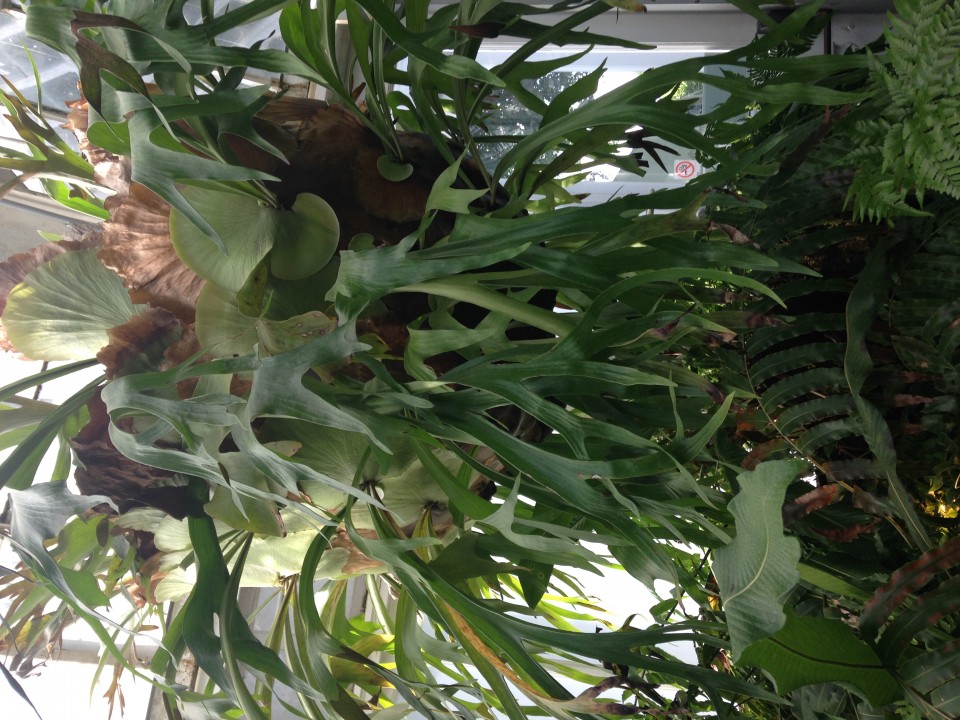
When I sit in this space, filled with ferns, light, air, and space, it makes me feel a lot like I’m being hugged.  The image directly above is a hanging Staghorn and the leaves that drape down almost appear as hands that might pat me on the head while offering me an oatmeal cookie and a glass of milk.  The energy of this space is fertile, abundant, and centered.  It is the embodiment of the heart chakra.  Sometimes, I place my hand in the leaves and allow the energy to roll up my inner arm directly into my heart-space.  Have you ever played with a plant with an exchange of energy?

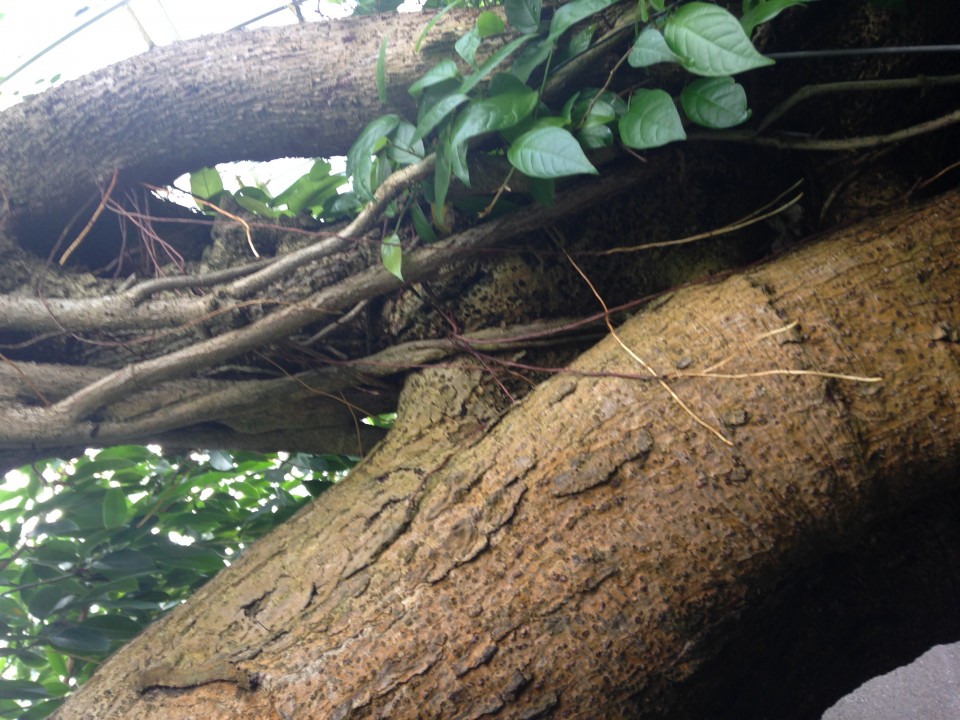
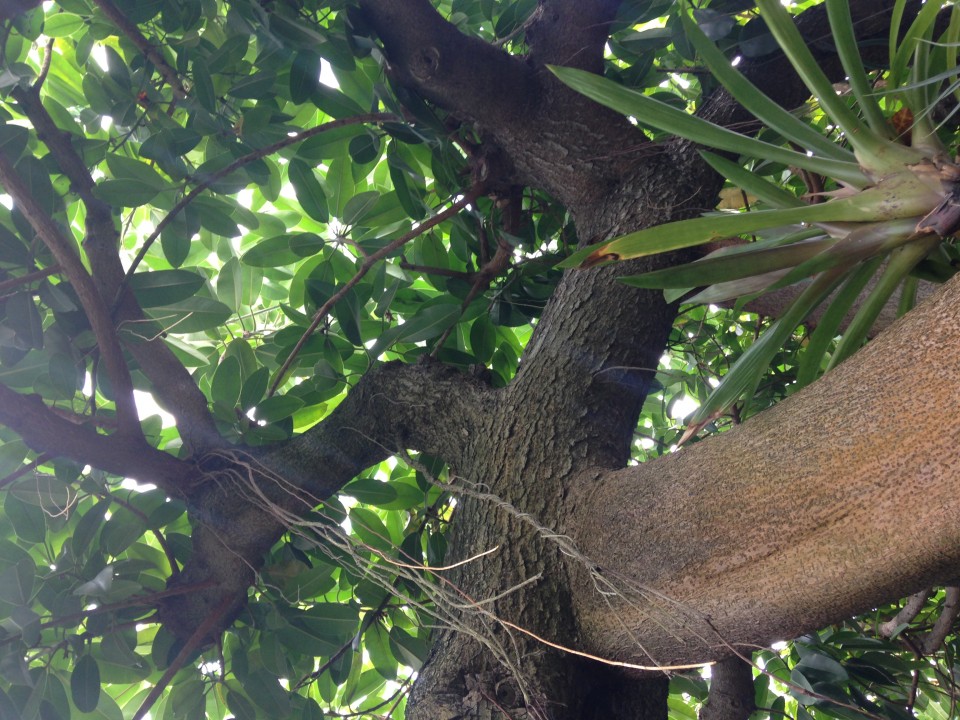
I have a beautiful friend who has some favorite trees that he likes to hug.  While it seems he is an equal opportunity tree hugger, there are some specific trees that he has a long-term relationship with.  When I watch him hug one of his tree friends, trees he has been hugging since he was a child, I can see his whole face and body relax.  What he receives from the tree, he also gives to the tree.  He really is one of the first people I have ever seen exchange energy with a tree.  Sometimes we use the term “green thumb” to mean someone who is good with plants.  Perhaps they can listen to plants and the plants tell them what they need to thrive?  Wouldn’t it be wonderful if we could all learn to listen to the trees?  One of the trees that I am developing a close relationship with is a ficus from Nepal that is in the orchid room at Phipps.  The ficus was added to the collection in 1849.  Go ahead and let that sink in.  I love to press my temple into this grounded being and reach one hand up to press into a higher branch while reaching another down to press into the trunk.
img_7400

How many people have walked beside this ficus newly engaged, with their baby, in their immeasureable grief, on their wedding day, upon the joy of a visit from a beloved friend from afar, to celebrate a holiday or birthday or special occasion? This tree has witnessed it all, but not in silence.  No, the ficus has a deep and grounded vibration.  When I stand close, it absorbs low vibration from me and sends them down deep into the earth and returns high vibrations from it’s wisdom branches that face towards the sun.  Surrounded by fragrant and jewel-toned orchids, the ficus does not fear my worst or suffer from my offering.  I give, I breathe, I receive.  If this isn’t friendship, then what is?
img_7402

When we think about pilgrimage, we think of a destination, but my time with ferns and new friendship with a very special Nepalese ficus have made me wonder if we can also pilgrimage to a new geography of awareness.  In Charles Genoud’s poetic “Gesture of Awareness” (page 116), he suggests that

We may wonder where the body’s awareness is, imagining it’s in the body, but the body’s awareness will only be in the body if we stand outside ourselves trying to figure out where it is.

I can’t tell you how many times I have read Genoud’s book. While I have always had a strong affection for the practice suggested in his teachings, not all of it makes sense.  I have been practicing yoga techniques for enhancing my awareness for 25-years, but this concept above has not been applicable to my practice for all this time.  With my new connection to the vibration of plants and trees, or, rather, with my willingness to open to the vibration of plants and trees, I start to feel a glimmer of understanding.  Awareness is the softening of my friend’s beautiful face when I watch him hug his friend with his arms wide and face and chest warm and open against the bark of the trunk.
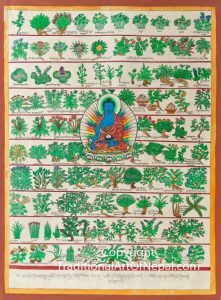
medicine-buddhaNot locating awareness in the physical body allows for a new geography to be explored.  It is the geography of space, perhaps that space that we know to be mapped by mandala. The pilgrimage here, then, is not internal, but it is to an entirely unique geography.  The palms of our hands have an energetic connection to the pericardium, the casing around the heart.  Even if it feels silly, perhaps you want to play?  Just pick a tree that calls out to you.  The more ridiculous this seems, the more you might need this for your soul, your well-being, and a full expression of heart-mind.  Gently place your palm on a place on the tree that calls to you for touch and connection.  Trust your instincts here.  The tree will welcome you.  You know what to do.  Take a few deep breaths into your palm and let the energy of those breaths flow up your arm into your heart space.  The color of the heart chakra is green.  You can do this.  Feel the leafy green tendrils of your heart open to the tree, be fed by the tree, sent laughter and wisdom by the tree.  From your heart to the tree, send it back through your inner arm, wrist and palm of your hand.  You are smiling because this is so important and liberating.  You can’t help yourself.

If you are not free to be out among trees for any reason, then go there in your mind.  Practice wherever you are.  As you practice, the geography of awareness will unfold like a forgotten map to a secret garden that has not been tended to in many, many, years.  This is an important yoga.  This is life.

Written by Sharon Fennimore, a yogini, teacher, and global doula who loves to pilgrimage each and every day to find the sacred in all that is around us in image, experience, and nature.  This post is for Jason, who brought me to the Allegheny National Forest for the first time in my life and, in doing so, changed the geography of my heart-mind forever and my most generous and beloved Aunt Patty who treats me to a membership at Phipps so I can spend as much time as I want with the ferns.


Pounding On An Open Door

“How long will you keep pounding on an open door, begging someone to answer?”  ~Rabia

As soon as I read this quote, I knew it was a question I needed to deeply consider.  It was illuminating to read this because I immediately visualized myself pounding furiously on the open door of life hoping that someone would arrive to help me find my way through.  Yet, there is no need to pound on the door, to kick, scream, beg or demand because the door is already open.  You can walk through, just as you are, right now.

According to the Bhagavad Gita, “There has never been a time when you and I have not existed, nor will there be a time when we will cease to be.  Therefore, play the role you’re meant for right now.”  It’s so hard to accept this in the busy, fast paced life of self-improvement projects that we all live in right now.  My clients all present various anxieties and fears that they are, at the same time, doing too much and missing a certain joyful quality in their lives that they are certain “should” be there and not doing “enough”—to be good partners, good parents, good employees, good citizens of the world.  We are overwhelmed with the sense that something is amiss and that we don’t have a right to just walk through the door and experience the joy that is being alive.  So, we improve ourselves and pound and kick away at the door only to find that there is no bell because there is no one to receive us.

A month or so back, I was attending a Quaker meeting and someone rose and quoted Micah 6:8 from the bible: “He has told you, O man, what is good; And what does the LORD require of you But to do justice, to love kindness, And to walk humbly with your God?”.  Ever since then, the word “kindness” has been coming up for me absolutely everywhere.  Later that same Sunday, I was in the library and the first book I saw was this little, almost pamphlet sized book by Ajahn Brahm called “Kindfulness”.  I checked a book called “Love Kindness” by Barry H. Corey out of the library.  The more I thought about it, the more I realized that cultivating kindness was part of my divine life journey.  Later in the same meeting, someone stood and told a story about how they were really pleased when the principal of their child’s new school asked that all students have respect for one another and their teachers during the orientation, but she thought that what they should really offer one another was kindness.  Kindness, she went on to say, is what is due to all humans, no matter what.  Respect, on the other hand, is earned.  I found this to be profound.  We do not have to earn kindness and we should not ask anyone else to earn kindness from us either.

How are all these things linked?  Well, honestly, I don’t know.  For me, reading is a part of my practice. When these types of ideas present themselves to me through my spiritual life, in my readings, and in my daily life, I try to pay attention.  Even on a surface level, I have to believe that expressing ourselves authentically, walking right through that open door and being gentle and kind to all the other people we meet is a path to great joy for ourselves and everyone that we meet.  How do we get the courage and grace to do this?  Practice.  It takes a lot of practice so that we have compassion for ourselves and others, so that we are aware and so we are mindful of our power to take actions that either improve or decrease the quality of life for everyone we come into contact with.  For today, no matter what your circumstances, offer at least five strangers your brightest and deepest smile.  Tell at least someone you know something that they do that you are truly grateful for or just tell someone that you notice them and all that they do.  Release your narrative in a relationship and just give your special someone a hug and tell them that you are so happy they are there—because, yes, they probably press your buttons and shrunk your favorite sweater and can’t help but burn toast every morning—but what is most important, is their beautiful presence, the light they shine in your life, your house, your family.  I am convinced that offering everything with “kindfulness” will not only profoundly improve my quality of life, but it is a step towards peace in my house, in my community and my world.

Written by Sharon Fennimore, a yogini teaching yoga, meditation and providing integrative health coaching services to women and families with young children based in Pittsburgh, Pennsylvania.  Join my online community Make Room!

Day 4: Week One, Yoga with Rodney Yee

“It is crucial to learn how to open your upper chest and your arms with increasing relaxation in your neck and sense organs (Yee, 54).”

“The repetition of Tree Pose and Warrior I in the following sequence lets your body make its own
subtle adjustments to bring understanding and ease in the poses (Yee, 54).”

Ever since I went back to working a job where I spent the majority of my time sitting in a chair in front of a computer screen, I have felt my chin migrate forward and I can just FEEL my whole head in front of my spine.  It’s awful and it feels wrong.  I try to remember to draw my chin in towards my heart and release my shoulder blades down my back during the day, but it is really challenging.  When I finally get a chance to stand up, I feel desperate for a stretch.  I just want to get into downward facing dog and feel the weight of my head releasing down from my spine instead of creating compression and tension as my atlas bone shouts for relief.  So, yes, I agree—–it is crucial to keep the upper chest open with a relaxed neck and sense organs.  Of course, easier said than done!  I find it easier to address this task on the mat than in my “real life.”

As a teacher, I feel my students who are frustrated about the way their bodies perform and find shape in the asanas.  The idea that we can allow the interior intelligence of the body to find full expression through the practice of asana is one that we all want to believe, yet we find it hard to imagine.  We want to believe that we could yank or pull ourselves into a certain shape.  Or, better yet, if our instructor could just help us “make it happen” with a magical adjustment.  Even after many years of practice, I was rather skeptical that the repetition of Tree Pose and Warrior I was going to do much else but strain my body.  Amazingly, it did not strain my body and, by the third set of tree poses, I felt significantly taller through my entire body.  My arm pits seemed to rise with greater ease up and away from my hips and I felt elevated.  Really.  Almost without trying!

Please feel free to join me in my 8-week program with Rodney Yee. You can share your own experience by leaving comments on this blog. It’s OK if you start on a different day or we get out of sync. This is going to be fun!

Posted by Sharon Fennimore Rudyk, the fearless leader of Team Matrika. Are you in Pittsburgh, PA? Join us for a great class at Yoga Matrika in Squirrel Hill.

Day One, Week One: Attachment & Weakness

A few weeks ago I threatened to start Rodney Yee’s 8-week Home Yoga Practice program from his book, Moving Towards Balance: 8-Weeks of Yoga with Rodney Yee and blog about my experience.  Today, I’m making good on my threat.  It’s Day One of Week One.

Today’s practice involved practicing multiple versions of some standing poses.  Already, I’m kind of frustrated.  After twenty-years of practice, I like doing these poses the way I like doing these poses.  So, today, I met the beast of attachment head on and I did the poses the way Rodney wanted me to.  I’m still going to keep doing the poses my way, but once I got over my attachment issues, I did find that doing the poses in the variety of ways that the practice suggested, I was able to find different sensation in the poses.  It was really an invitation to feel the poses in a variety of different ways and this brought me into deeper awareness of sensation in my body and the alignment and use of my skeletal system.

I also discovered that I am weak.  Seriously W-E-A-K.  For each of the asana variations, we were instructed to hold the pose for 30-seconds.  I confidently came into Warrior II only to find that my whole body wanted to give in at around five seconds.  I have been holding poses for a mindful period of time, but only some poses that are a part of my regular Vajra Yoga practice.  Being forced to hold other poses took me out of my strength-zone and I was surprised to find out how weak I felt when holding poses.  In all fairness, I have been either pregnant or nursing a baby for the past 19-months and that is bound to exhaust a person and change strength and endurance in some ways and enhance it in others.

Finally, I should divulge that I did this practice in the center of my home’s family room with a sick five-year old sitting on the couch watching Pokemon videos and playing fruit ninja on my iPhone and my 9-month old dumping blocks out of a canvas bag near my head.  While in downward facing dog, my 9-month old crawled under me and pinched my boob.  Yes, you read this correctly—-she pinched my boob!  But, I have to say that I felt a whole lot more open, centered and, if not really relaxed, more prepared to continue with the day than I did before practice.  I mention this because so many adults feel that they can’t mke time for yoga because they keep waiting for the perfect moment, the perfect place or the time when they can have some peace and quiet.  Yes, ideally you can make your practice about taking some time for yourself, but if you can’t, then just push aside the crumbs and the toys—–roll out the mat over the chaos and make it happen.

Please feel free to join me in my 8-week program with Rodney Yee.  You can share your own experience by leaving comments on this blog.  It’s OK if you start on a different day or we get out of sync.  This is going to be fun!

Posted by Sharon Fennimore Rudyk, the fearless leader of Team Matrika.  Are you in Pittsburgh, PA?  Join us for a great class at Yoga Matrika in Squirrel Hill.

Practice What You Preach

For a couple of years now, the book I have used as a reference when planning Matrika Flow classes and that I consistently refer to my students that wish to develop their home practice is Rodney Yee’s text, Moving Toward Balance: 8-Weeks of Yoga with Rodney Yee.  I am very familiar with this book and feel that it has wonderful pictures, very clearly written instructions and well-conceived sequences.  I’ve always felt confident when I refer students and other teachers to this book.

But, if I’m going to be completely honest, I’ve never actually done the eight-week program.  So, it’s time for me to step up to the mat and practice what I preach.  My excuse has always been that I have a wonderful daily practice of yoga and meditation that I enjoy and I have never wanted to disrupt it.  Why would I change a good thing?  Well, there are LOTS of reasons why shaking things up a bit might be a good thing and I am going to make a commitment to this 8-week program.  My intention is to blog my experience and hope that you might join me on this two-month journey either by reading along or trying the program yourself and commenting on my blog entries with your own experience.Who knows, maybe I will read the Guide to Career Education
and get a start on writing my own book!


I am going to start my eight-week practice journey on Sunday, April 15th and end on Sunday, June 10th.  If you want to join me, please obtain a copy of the book before April 15th.  Want to let me know you are joining me?  Just comment on this post so I know I am not alone.  I’ll blog about my experiences and hope you will keep me company by posting about your experience with these practices or this 8-week program in general.

Meet you on the Mat!

Posted by Sharon Rudyk, the fearless juggler mamma at Yoga Matrika, an intimate space for the exploration of yoga, meditation and generosity of spirit in Squirrel Hill, Pittsburgh, Pennsylvania. 

Football, Swimsuits and the Yoga of Feminism

As I teach two prenatal yoga classes every week, I have the honor and joy of watching incredibly strong women embody the true spirit of Warrior poses.  I can actually see the energy rising up through the soles of their feet and into their core to support the amazing act of creation they carry within them.  There is a courage, a dignity and strength of force there that is palpable in the room.  It is, for me, an experience and one that brings me, each class, into a new appreciation for the beauty and strength that is woman. The energy of these movements is the embodiment of grace.  Grace representing the fact that each one of these women has opened their hearts to the potential for immense joy and immeasurable loss and grief.  No words are required.  Through movement and intention, the expression of strength and grace is clear and concise.

Last weekend, I was able to catch the very end of the playoff game between the Steelers and the Ravens.  While I can’t say that I am a fan of football in general, there is something so very beautiful about watching the Steelers right now.  The coordination combined with strength and expression of sheer will as well as the skill combined with brutality and violence is something to behold.  Not only are these men amazing athletes, but they have the courage to take a flying leap into a pile of men and to throw their bodies with incredible force and at high speeds into one another.  As anyone who knows me can appreciate, if a ball (or anything else for that matter) is coming my way, my only instinct is to duck and cover.  Therefore, I have this incredible awe and appreciation for what is being required of these men in this game.

After the game, we were flipping through channels and found the Miss America pagent.  It was already the swimsuit competition and about 40-women in identical black bikinis and heals were walking accross the stage in various choreographed formations.  Each one beautiful, young, in great shape, smiling and basically, half naked on national television.  I don’t have a problem with naked and these women were easy on the eyes to say the least. But, let’s be honest here– a bikini is really underpants and bra made for swimming and, well, you can’t swim in heels and I didn’t see a pool anywhere nearby.  Immediately, I thought of the national news stories of the past year that involved mothers being asked to leave airplanes and coffee shops because they were breastfeeding.  These mothers were offending those around them by, horror of horrors, exposing some of their breast!  The NERVE!  Even more GROSS—they were using this breast to, yuck,  feed their baby.  Did I mention, in PUBLIC?  And yet, here before my eyes were lots of breasts and bellies and butts on display all balancing on top of high heels for maximum effect.

And what was the effect?  I felt that the effect was that these intelligent, athletic and beautiful women were weakened.  After the bikini competition, they all ran off frantically to get on their ballgowns and then they raced around preparing for the talent competition and then they were given the time to answer one significant political or ethical question with a maximum of one sentence.  The whole experience gave the image of the ideal American woman as one who is perfect in every way, but frantic and weak as they rush mindlessly around trying to look good and irish dance and talk about globalism all while trying to balance on the tip of a heel on national tv in their underwear.  I felt none of the awe that I do in a room full of women doing prenatal yoga or the immense respect for the football players.

The more that I considered the issue, I continued to return to the idea of mindfulness.  The weakness of the Miss America contestants really had nothing to do with their dress or the different aspects of the competition, it was due to the frantic nature of the timing.  It wasn’t just whether or not they could meet the tasks required, it was about how fast they could meet each task.  The pregnant women are focused, the football players are focused, but the contestants were both naked and engaged in a process that took away their ability to be mindful.  It made them seem silly and took away from the actual value of their talents and accomplishments.  It made the winner seem arbitrary and, most likely, set all of the contestants up for some level of trauma.  How long must it take to process that experience when they didn’t even have a chance to experience it?

My conclusion is that there is great strength in mindfulness.  My analysis has shown me clearly that frantic behavior weakens even the strongest, most talented and intelligent.  The way that our culture supports the idea that multi-tasking is a virtue leads us to weakness and creates a kind of deep seated stress and trauma.  Making a commitment in the moment, centering through the intention of that commitment and then following through with grace is the only path to the result that we honestly desire.  Yoga and meditation provide us with the means for learning and practicing these skills in a safe environment.  No matter how frantic our rush to class was, how crazy our day, how stressed we feel, once we put out the mat and start to breathe we re-gain our strength.  We are no longer the young woman in her underwear and heels on tv trying to sing an opera while mentally preparing to answer a question about world peace.

Posted by Sharon Rudyk.  https://www.yogamatrika.com/ and http://www.matrikaprenatal.com

Yoga at Home for $2 a Month

There are a LOT of great reasons to practice yoga at home on your own:

1-You have work and/or family responsibilities that make it impossible to consistently get to a yoga class.  This may be especially true for new parents who are juggling jobs, childcare and EVERYTHING!

2-You travel often and wish you had a practice you could take with you on the road

3-It’s a great way to advance your practice and always do the poses and exercises that best support you in how you feel (if you’re calling the shots, then you don’t have to do any handstands if you don’t want to!).

4-If you are not feeling well, are injured or need a modified practice for any reason, you can learn how to do a practice that will help you feel better

5-You want to make yoga a part of everyday—a real part of your life and not just a class or workshop that you take every once in a while.

Many of my students ask me how to start a home practice and how to be consistent about practicing at home.  For them, and for you, I have designed a great home practice that can be done anywhere by anyone.  In just 10-minutes a day, you will feel a huge improvement in how you feel.  I am charging $24 for 12-months of home practice support.  Here are the details:

Yoga Matrika invites YOU to Make 2010 the Year
YOU Develop a Home Yoga Practice. 

We welcome everyone to become a part of this yoga-based resolution revolution!  You don’t have to live in Pittsburgh and we hope that EVERYONE will take advantage of this project that invites you to make yoga and meditation a part of EVERY day of your life in a gentle and flexible way.   This program is for yogis of all ages, experience levels and physical abilities. 

Here is how it works:

STEP 1:  Pay the fees for home practice or make a donation 

The cost for the basic home practice and one year of home yoga practice support is $24.  You can make a payment online at the bottom of this page.


STEP 2:  You will receive a BASIC HOME PRACTICE in the mail to the mailing address you provide when you make payment. 

This home practice will take most adults 10-15 minutes to complete.  Modifications for practice in a chair or lying down can be provided upon request. The home practice guide will include pictures and text that describe the poses and exercises.  If you ever have any questions, there will be support contact information provided in your WELCOME KIT.


STEP 3:  Every month, you will receive an e-mail newsletter that will provide an additional 5-10 minutes of practice ideas so that you can slowly expand the amount of time you are spending on your home practice through the 12-months of the program.


By the end of one year, you will have:

1-A basic home practice that you can do anytime and anywhere in 10-15 minutes.

2-Three different 1-hour long home practices that you can do:
    #1:  Home Practice for Low Back and Hips
    #2:  Home Practice for Stress Relief
    #3:  Home Practice to Relieve Tension in the Head, Neck and Shoulders

3-Home Yoga & Meditation practices for anywhere between 10-minutes and 1-hour so you will always have a plan for your home practice no matter how much or how little time you have. 


WHAT HAPPENS AFTER I SIGN-UP?

When you sign-up for home practice support, you will receive a Welcome Kit that will include the BASIC HOME PRACTICE.  The basic home practice is designed to take 10-15 minutes and includes some breathing practices, stretching and relaxation.  We suggest that you start by making a commitment to doing 10-minutes of yoga a day for 5-days per week.  It’s more important that you are consistent about practicing every day than the amount of time you spend every day. You will be amazed at how different you feel with just 10-minutes of practice! 

One month after you sign-up for the home practice support, you will begin to receive monthly e-mail newsletters that provide an additional 5-minutes to add on to your basic practice until you have an hour-long home practice with variations for low back and hip care, stress, and tension in head, neck and shoulders.  You will also receive yoga and meditation tips in every newsletter that will help inspire your practice and keep it fresh.  It is ALWAYS your choice how much or how little of the practice you do.  This practice is designed so that, no matter how much or how little time you have, you can always have a great plan for a 10-minute, 20-minute, 40-minute or hour long practice and everything in between.

You don’t need any special equipment or clothing to practice yoga at home.  It is suggested that you decide on a place for your practice and consistently use that place (it can be ANYWHERE that you have floor space—kitchen, hallway, ANYWHERE).  Many people find that it is helpful to have a yoga mat and to keep it within view so that you can just throw your mat down and practice when you have a few minutes. 

We also recommend that you take a minimum of 2-yoga classes a month with a qualified teacher at a studio in your area.  It’s a good idea to go to a class so that you can receive adjustments to your poses, be a part of a supportive yoga community and receive the benefits of an inspiring practice. You will learn new poses and new ideas and you can always incorporate what you like the most into your home practice.   Practicing on your own and practicing with a group is a very different experience.  It’s important to have both of these types of experiences in order to advance your practice AND to keep your home practice fresh and exciting.

Your 2010 home practice will also include reading the following two books:

1.  Reinventing the Body, Resurrecting the Soul
     by Deepak Chopra.  2009

2.  The Joy of Living: Unlocking the Secret and Science of 
    Happiness
by Youngey Mingyur Rinpoche.  2007

Each monthly e-newsletter will include information from these texts to inspire your practice and to keep your practice engaged with yoga philosophy.

You don’t have to buy these books, but we think you’ll want to so you can read them again and again and again!—You can borrow them from the library, create a home practice group with friends and collectively own one set of the texts, etc.  If you do buy them and you have a local book shop, please order it through them or ask them to carry these titles.  If not, then the book titles are linked to information that will help you purchase them online.  If you live in or around the Pittsburgh Metro area, we recommend Joseph Beth Booksellers on the South Side.  They should have these books in stock for you or they can order them!

If you are interested, please go to  https://www.yogamatrika.com//practiceyoga-at-home/
for more details and to sign-up for home practice support.

Posted by Sharon Fennimore Rudyk
Owner and Director, Yoga Matrika

http://www.sharonrudykyoga.info
https://www.yogamatrika.com/
http://www.prenatalyogapittsburgh.com

Qigong and Yoga: What is Zhong Dao?

It’s always a risk to put a class on the schedule that has a name that no one recognizes.  I have taken just this kind of risk by creating Zhong Dao.  But, the name is such a perfect reflection of this combination Qigong Energy work and Yoga class that I just can’t call it by any other name!

First, I think that we can examine what the different elements of the class are for clarity.  One aspect of the practice of Zhong Dao is inspired by Qigong.  Qigong is a system of exercises that allow the practitioner to “learn how to control the flow and distribution of qi to improve the health and harmony of mind and body (Cohen 3).”  What precisely is qi?  Qi (pronounced: chee—as if you were going to say cheese without the “se”) has been translated in many different ways, but one that can be helpful for beginners and is especially appropriate for this context, is that qi is life energy.  Gong means to work.  Qigong is a “wholistic system of self-healing exercise and meditation, an ancient, evolving practice that includes healing posture, movement, self-massage, breathing techniques, and meditation (Cohen 4).”

Second, what is the connection between this Chinese Qigong practice and yoga?  “In India, the life energy, prana, is described as flowing through thousands of subtle-energy veins, the nadis.  One of the goals of Yoga is to accumulate more prana through breath control exercises (pranayama) and physical postures (asana) (Cohen 26).”   One system of Yoga that has incorporated Chinese yin-yang theory is Yin Yoga.  One of Paul Grilley’s students, Sarah Powers, has written a beautiful book called Insight Yoga that shows the Chinese energy patterns (meridians) and yoga asana that activate different energy meridians in the body.

Zhong means middle or center and Dao means path or way.  Therefore, this practice is the middle way and a way to create a sense of balance and ease in the body and mind.  This practice is designed to relieve stress and tension in the body so that there is equilibrium in the spirit, the immune system is supported and optimum health can be maintained.  We do some gentle stretching and energy warm-ups followed by a practice of the Eight Brocades and end every practice session with a healing meditation.

Hope to see you on Saturdays for Zhong Dao at 10:30am!

Here are some excellent references for Yoga and Qigong:

The Way of Qigong: The Art and Science of Chinese Energy Healing.  Written by Kenneth S. Cohen.  Ballantine Books, New York: 1997.

Insight Yoga.  Written by Sarah Powers.  Shambhala Publications, Boston & London: 2008.

Yin Yoga: Outline of a Quiet Practice.  Written by Paul Grilley.  White Cloud Press, Ashland, Oregon: 2002.

Happy Happy,

Sharon Rudyk
Owner and Director, Yoga Matrika
https://www.yogamatrika.com/
http://www.prenatalyogapittsburgh.com

YOGA MATRIKA is located at 6520 Wilkins Avenue in the Squirrel Hill/Point Breeze neighborhoods of Pittsburgh, Pennsylvania.  You can reach Sharon by calling (412) 855-5692.

Walking on Earth

There is a Chinese proverb that says that:

The miracle is not to fly in the air, or to walk on the water, but to walk on the earth.

This is the same with a yoga practice.  Over time and with intelligent stretching practices, the body will open and become more flexible.  With practice, beginning yoga students advance in their alignment and ability to do a greater variety of poses.  It is truly beautiful to see an experienced yogi express the spirit of a pose with a deep and profound expression of grace.  Advanced students create a flowing meditation through soft and easy breath and the control of balance and energy through bandha work and reflection on the philosophy and science of yoga. 

While these are all beautiful reflections on the potential of yoga to create balance, ease and strength and grace, I see the miracle in the beginners.  It starts with the honesty of effort and the realisation when new students see that even by drawing their awareness to the breath, without changing anything at all, everything changes.  The miracle is not the perfect pose after years of training, the miracle is that moment that new students have when they realise that it is just being present in this moment that has the power to change the course of a life.  The miracle is not a one-armed handstand, it is standing in tadasana–mountain pose—with weight balanced across the feet and the head, heart and gut one on top of the other.

The Miracle of Standing on Earth Practice:

Take your shoes and socks off and allow your feet to breathe and soften into the floor beneath you.  Wiggle and spread your toes and feel the pressure of your feet on the earth and the earth on your feet.  Evaluate the distribution of your body weight accross your feet and see if you can move in a way that allows you to equally balance the weight of your body across the pinky toe, big toe and heel of the feet.  Press your inner ankles towards your outer ankles and roll your thigh bones back as you tuck your sitting bones underneath you.  Feel the lift of the navel and heart as you relax your shoulders down and away from your earlobes.  Stretch the crown of your head towards the sky and slightly bring your chin towards your heart as you relax your forehead, neck and jaw.

Breathe here in this place of where you stand.  Notice sensation in your feet, legs, belly, lower back, lungs, heart center, shoulders, arms and hands.  How do the bones of your face, neck and jaw feel?  There are no right or wrong answers.  It’s just what you feel right now.  Each and every time you do this exercise you will feel different.  It’s the miracle of standing on earth.

With affection,
Sharon Rudyk
Director, Yoga Matrika
A beautiful yoga studio community in Pittsburgh, Pennsylvania.