Spring Preparation #6: Make a Commitment

The kind of commitment that I’m talking about is also sometimes referred to as “put your money where your mouth is.”  You know that you want to make a commitment to developing your yoga practice, your meditation practice or both.  Maybe you’ve been meaning to try yoga for a while.  Perhaps, after the 15th article you’ve read this month about the benefits of meditation you feel almost obligated to give it a try.  Maybe you’ve let your mat get dusty this winter or it might even be frozen in your trunk?

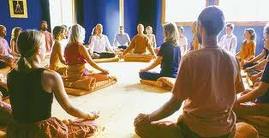
Whether you’ve never done yoga or meditated before or you’ve been a yogi at heart for forever, this season of renewal reminds us of the value of commitment.  Registering for an 8-week small group series with Sharon for this spring is an excellent way to ease yourself back on your mat or cushion or find out what all the buzz is about for yourself for the very first time.

Here are just some of the benefits to committing to a private small-group class over dropping-in on large studio classes:

  • You have the opportunity to develop a relationship with your teacher and your fellow students.  You know that this small group will notice your absence and you will miss seeing them too and these relationships help you get to class when you aren’t quite feeling up to it.
  • You write the dates and times on your calendar and then you make it happen.  If you have to arrange a babysitter, then you do it.  If you have to figure out what bus you are going to take, you find that schedule.  When it is on your calendar, then you do it. Making a class a habit is an excellent way to make sure that you actually attend.
  • In a small group you get the attention and support you need to learn new skills.  With an 8-week series, the material can be presented in a consecutive way.  The instructor can get to know you and your special abilities and is prepared to modify your practice just for you.  No more hiding in the back of the room just hoping you don’t hurt yourself!
  • Let’s be honest.  You spent the money and now you are going to show up.
  • When you make a commitment, a whole new realm of opportunities will open up for you.  Whenever you make a commitment, it means saying “no” to other things or people.  But, it also means that a completely new set of possibilities will be revealed to you.

Stop talking about doing yoga or learning how to meditate and SIGN-UP.  See you in April!

This post was written by Sharon Rudyk, an independent yoga and meditation instructor in Pittsburgh, Pennsylvania.  Read more about Sharon on her website.

Spring Preparation #5: Spring Ahead in Time

This Saturday night (Or on Sunday morning when we wonder why we are at church/yoga class/work when everyone else failed to show up and know quite honestly that it isn’t about moral superiority …..) we will change our clocks so that they are an hour ahead.  In a pessimistic essence, we lose an hour of sleep and then, by Sunday evening, we’ll have trouble falling asleep as it will feel way too early to turn in.  In our most optimistic essence, we could see this as a head start.  Taking a middle path, we can take this opportunity to explore our attachment to time and re-negotiate our relationship to time.

Here are two books that I can recommend that may help you think about time in a different way:

Infinite Life (2004) by Robert Thurman
This is a series of meditations and spiritual guidance that suggests we can be happier if we live as though our actions and thoughts have infinite implications for both our own happiness and the happiness of all living beings.  The meditation guidance is valuable both for beginners and for experienced meditation practitioners.

Einstein’s Clocks, Poincare’s Maps (2003) by Peter Galison
In this book, Galison explores how Einstein and Poincare’s ideas about time and space changed how it was possible to think about simultaneity and the way that physics, philosophy and technology were changed by these ideas.  Within this history of science narrative is a complex story of how the perception of time changes and the social and political implications of both our understanding and use of time.

Written by Sharon Rudyk, an independent yoga and meditation instructor in Pittsburgh, Pennsylvania.  Check out my teaching schedule online at https://www.yogamatrika.com/.

Spring Preparation #4: Nourish the Spring Body

In this season, we should be nourishing the body by adding foods that support the yang qualities of spring:

  • Drink mint tea with honey
  • Cook with pungent herbs: basil, fennel, marjoram, rosemary, caraway, dill & bay leaf
  • Whole grains, legumes and seeds
  • Beets, carrots and sweet starchy vegetables
  • Cook vegetables at a higher temperature for shorter periods of time
  • Emphasize raw and sprouted foods
  • Eat moderate amounts of food and avoid late meals

All of these ideas were taken from a fabulous nutrition reference:

Paul Pritchford.  Healing with Whole Foods: Asian Traditions and Modern Nutrition.  Third Edition 2002.

Spring Preparation #3: Laugh Outloud

I understand that ironic humor is perhaps an acquired taste, but if you have the taste for it, then I highly recommend the book Half Empty by David Rakoff.  In this intelligent collection of essays, Rakoff explores the darker side of optimism which is sometimes better known as pessimism.  As dark as the essays may get, this is the first book that I have read in a long time that made me laugh outloud on a public bus.  Usually I can control myself or manage a little chuckle that could also be interpreted as a facial tic or perhaps having  something stuck in my teeth.  But, this book made me laugh in an unmistakable way and loud at that.

I imagine that it says a lot more about me as a person than it does about the book itself that a collection of essays on pessimism is what brought me into public peals of laughter, but I still recommend the book.  It’s delicious spring reading at its very best.  Dark enough that it doesn’t give you a cavity, but intelligent and funny enough that it gets you through a challenging week with a smile on your face.  Priceless.

Spring Meditation #2: Yoga to Balance the Liver

Spring

The water murmurs
In the old stone well,
And, a rippling mirror,
Gives back the clear blue sky.
The river roars,
Swollen with the late rains of spring.
On the cool, jade-green grass
The golden sunshine
Splashes.

Sometimes, at early dawn,
I climb
Even as far as Lien Shan Temple.
In the spring
I plow the thirsty field,
That it may drink new life.
I eat a little,
I work a little,
Each day my hair grows thinner,
And, it seems,
I lean ever a bit more heavily
On my old thornwood cane.

~Liu Tzu-Hui, Sung Dynasty, AD 960-1278
[This translation from Beinfield and Korngold, page 160]

With the coming of spring, here is a gentle yoga-based exercise to balance the liver energy in the body.

The energy of the liver (or, “Liver Meridian”) starts at the inside base of the big toe and runs up the inside of the leg, goes through the reproductive organs and flows under the front of the ribs into the liver where it circulates upwards through the lungs.  This energy line controls the eyes and the nervous system.

Part 1:
For those of you who are familiar with “Bridge Pose” then this exercise will make more sense.  If you are not familiar with “Bridge Pose” then check out this description here.

Start: Lie on your back, bend your knees and place the soles of your feet on the floor with your heels as close to your sitting bones as possible.  If you can, grab your ankles with your hands.  If you can’t reach your ankles or that is uncomfortable, then place your arms by your sides with your palms facing down.

Exercise: Inhale and lift up through your thighs and pelvis and exhale as you slowly lower down.  Relax for a few breaths and then come up again as you inhale and stretch up as high as you can through the thighs and belly.  Tighten your buttocks then contract a little bit more and really squeeze.  Then relax your body as you slowly lower down.

End: Release your ankles and then lie down on the floor.  Rest and relax completely with your legs stretched out in front of you and your entire back resting on the floor.

Part 2:

Start: While still lying on your back, reach your arms up so that your palms face one another and your fingers are reaching towards the sky.  Take a deep breath.

Exercise: Make fists with your hands and squeeze the muscles in your arms.  Slowly exhale as you bring your fists down towards your chest.

Do this four times—–inhale and reaching up through the arms and exhaling slowly lower your fists down towards your chest

End: Relax on your back with your arms by your sides.

Part 3:

Deep relaxation: Lie on your back with your arms by your sides and your palms facing up.  Set a timer so that you can completely let go for a minimum of 5-minutes.  Relax your body completely and just feel your breath fall into a natural pattern.

SOURCES

Beinfield, Harriet and Efrem Korngold.  Between Heaven and Earth: A Guide to Chinese Medicine.

Gach, Michael Reed and Carolyn Marco.  The Acupressure Stress Management Book.  Acu-Yoga: Designed to Relieve Stress and Tension.

Spring Meditation #1: Faith

Each year, in preparation for spring, I read this book:

Faith: Trusting Your Own Deepest Experience
by Sharon Salzberg

In my practice of both Catholicism and Judaism, I always appreciated the statements of belief that come at the beginning of a mass or service.  I like the idea of a gathering of people who very clearly state, up front, what joins them together and what they wish to publicly announce as their main practices and beliefs.  It’s a very powerful feeling to be a part of that prayer.  The ability to state, with such certainty, these statements of belief that provide the foundations that both define the religion and the basis of the prayers and practices of that religion, requires faith.  By repeating these statements, and especially by repeating them as a group, they provide a significant structure of support for those beliefs and practices.  But, it isn’t belief that brings that group together.  It is faith.

This book by Sharon Salzberg is a profound exploration of what faith is and how it continues to work as a powerful force even when we feel that we have lost it.  Although it is written from a Buddhist perspective, or, at the very least, the perspective of a Buddhist, the ideas can be applied to the human condition in general and are not specific to any particular religious practice.  Perhaps, a Buddhist exploration of the idea of Faith can be so open precisely because questioning is an important part of Buddhism.  Practitioners are told not just to believe, but that they should practice and see what the reality of their own experience is.  Not only are you not going to hell for asking the question, but questioning is an integral part of the faith and practice.

Why this book?  Why spring?

First, I learned this concept of re-reading certain books at certain times of the year from my mother.  Each December, she would sob her way through the New York City subway system reading Charles Dickens’, Christmas Carol.  The first time I read Faith it was in the fall and I was drawn to re-read it that spring.  It has become my “spring book” and this ritual is part of my spiritual preparation at the end of winter, when I just can’t take one more minute of cold or darkness, to remember that the seeds of spring have been cradled and nurtured deep within the earth the whole time.

Second, I learned to see that our biggest and smallest choices in life reflect our faith on a daily basis from my father.  At a speech he gave at my first wedding rehearsal dinner, he expressed the idea that the act of getting married is one that reflects our ability to have hope and faith.  If we didn’t feel like we could carry love into the future, we wouldn’t do it.  Even with the awareness that marriages fail, the act of getting married reflects a faith that it is also possible that some will not fail.  Our ability to have faith in our relationships, even while knowing that the people we love and that love us the most are not perfect and can’t be loving all the time is a spiritual practice.  This preparation for spring and considering the role of faith in my relationships, my work, my family and in my own choices is an important ritual that, just as powerful as a statement of belief, helps me to re-gather my spirit after a time of darkness.

Third, the truth is that I start to lose it by the end of winter.  The kind of “losing it” that requires more than a new lipstick to feel better.  Reading this book on faith reminds me that the seeds of spring have been cradled deep in the earth all winter long.  It is only my inability to see the life and to focus only on what is not living that causes my discomfort and un-ease.  Within the ground, not even that deep, lie the bulbs we planted this last fall.  They are happy and safe in the darkness of the earth, resting all their forces for the burst of life that will come when they feel the sun start to warm the surface.  And this, of course, is a wonderful reminder that I can choose my focus and my perspective at any time, in any season and apply this lesson of spring to all the winters of my life.

Just Twenty-Days

In just twenty-days it will be spring.  For any readers in parts of the country where it hasn’t snowed or dropped ice every week since Thanksgiving or where you have had more than five days of sun in the past four-months, perhaps the significance of this announcement escapes you.  But, for my gentle readers located in places in the world where this type of environmental stress has been a part of your daily life for over a quarter of the year, you know in every cell of your body and every corner of your soul what the true meaning of this revelation is.

It means that our faith has not been misplaced.  It means that our desire for light, for transformation and creativity is about to be answered.  There have already been subtle signs of the changes in energy and season here in Pittsburgh.  The sky is lighter earlier in the morning and stays lighter well past 5:00 pm.  In the morning, early song birds send their sweet message into the air.  In even the darkest corners of the brownest patches of earth there are the tips of bulb greens reaching out, digging out, and pushing towards the sky.

In honor of this special 20-day period, I will be posting a spring countdown message each and every day with a suggestion of a poem, reading, meditation, visualization, nutrition and/or activity to support this change in seasons.  As much as we desire spring to be with us right now, this is an excellent opportunity to prepare mentally, spiritually and physically for this change of seasons. I hope you will join me in savoring this release of darkness and moving towards the light and color of spring in a holistic way that recognizes not only what is lost, but also what is gained.

Prenatal Yoga Pittsburgh

MATRIKA PRENATAL YOGA & EXERCISE

Group Class:
Sundays from 12:15 to 1:15 pm at Mookshi Wellness Center
$5 for your first class

Private Classes:
Available at your convenience.  Schedule by calling Sharon (412) 855-5692.  FREE phone consultation for all expectant women.  Call to schedule yours today!

Matrika Prenatal is a practice available to women in all weeks of pregnancy and does not require any prior experience with yoga or meditation.  This unique combination of yoga, meditation, exercise and childbirth preparation supports expectant women through a healthy pregnancy, labor and birth preparation and beyond.  Gentle stretches and movements ease tension, improve circulation and help relieve common minor pregnancy complaints from insomnia to low back pain. Strengthening exercises and squatting help prepare the pelvic floor for labor and help mom maintain excellent cardiovascular health and endurance. We visualize birth, practice breathing and sounding techniques and discuss birth options including pain management through movement, breathing and sounding.  Of course, we also have a lot of fun and it’s always lovely to connect with other pregnant women in your community!

Benefits of Yoga and Meditation During Pregnancy

Physical

  • Gentle movements improve posture so that you carry baby correctly and prevent backache
  • Improved circulation mean less varicose veins, hemorrhoids and fluid retention
  • Relieve fatigue
  • Alleviate minor discomforts such as heartburn, pain in hip joints and ribs, muscle cramps and headaches
  • Strengthen the body and learn poses that you can use during labor for comfort
  • Learn pelvic floor exercises and other techniques for strengthening your body for birth
  • Stay toned and fit during pregnancy. Fit moms recover faster from birthing.

Emotional

  • Balance mood and learn to center body and mind
  • Connect deeply with your baby before they are born

Social

  • Meet other expectant mothers
  • Be a part of a supportive community
  • Have fun!

Spiritual

  • Take the time to be quiet during this pregnancy
  • Access your own strength
  • Become aware of your fears and learn to work with yourself, your baby and your care providers with confidence
  • Know yourself and be better equipped to communicate your needs and desires to your birth partner, care providers and family
  • Create a sacred and special time to relax, hope and dream

What to Expect in a Matrika Prenatal Class

We do not expect prenatal yoga students to have any experience with yoga. Our prenatal yoga classes are appropriate for women in all weeks of pregnancy. Although each instructor has their own style and may provide a different emphasis or tone to their class, all classes include some stretching and breathing exercises, some asana (yoga poses) that will tone and strengthen the body and relaxation. There is no wrong way to do yoga and the more often you practice, the more familiar you will become with the poses. As you become more familiar with the poses and exercises, then you can turn your focus inward. Although some poses may be challenging and you will feel the stretches as you create greater flexibility in your body, you should never feel pain in a yoga class. This is true in any yoga class and not just prenatal yoga! If you are ever uncomfortable or have questions, your instructor can help you modify a pose or answer any questions that you might have. Our classes are intimate and non-competitive so you can receive personalized attention from well-trained instructors.

Our classes are not just gentle yoga classes modified for pregnancy. Our prenatal programs are designed specifically for pregnancy and we use yoga to prepare for birth and for being a mother. Labor, birth and mothering a newborn are not easy tasks. The focus, strength and awareness that you learn in prenatal yoga classes will give you the skills you need to meet these tasks with confidence. We support one another and the entire Matrika community is here for you now and after you have your baby.

Mom & Baby Yoga

Mom & Baby Yoga

Thursdays 11:15 to noon 
$10 (exact cash, check or credit cards accepted on site)

This is a class for moms to share with babies up to 6-months or crawling (whichever comes first).  We start our practice with some gentle stretches for mom to relieve head, shoulder, neck and head tension and some exercises to prevent or support healing of carpal tunnel pain.  Then, we move on to yoga for baby.  Yes, you read that correctly—yoga for your baby!  Babies love being gently touched, singing songs and mindful movement.  Then, we close with some stretching and stretches for mom and a deep relaxation for everyone. No experience required!  Just pack some diapers, be prepared to feed your baby on demand during the class and bring a blanket for baby to lie on during class.

Doing Yoga Together: Preparations and Expectations

You love yoga and now you want to make it a part of your child’s life too. We are delighted that this is the case and we have a few things to keep in mind that will help you and your child enjoy the experience.

Keep an Open Mind

We find that it takes a couple of visits to the studio for children (ok, it’s actually true for adults too!) to understand what the activity is and what is expected of them. You might find that your child acts bored or is not interested in doing yoga. The way that babies and children enjoy yoga classes may be different from the way that you enjoy them. What we know is that, over time, sharing yoga together with your child creates beautiful memories and is time that you will cherish forever.

Prepare for Class

As much as possible, make sure that you and baby have had a snack and are wearing comfortable clothing. Try to leave enough time to get the studio so that there isn’t a lot of stress before class. Bring your little ones favorite toy or comfort item and some snacks as appropriate. Bring a receiving blanket for newborns and pre-crawling infants and a change of clothing and more diapering supplies than you think you need. For young children, after the first class, make sure that you talk with them about it and start talking about it again a few days before class—–remind them of the teacher’s name, another child’s name or some feature of class that they remember (a story, a sound or ritual).

Enjoy the Moment

When we release our expectations, we can enjoy whatever is happening. This is yoga! Yoga together is very different from adult yoga, but it allows us to stay fit and take time to meet our own needs as adults while sharing something that is very important to us with our children. Sometimes it goes as planned and sometimes it is a bit of a disaster, but know that you and your child are never judged at Yoga Matrika. There isn’t one of us who haven’t had a child tantrum during a Mom & Baby class or who didn’t have a baby who cried through an entire class——we welcome you and your little one, even if you are having “one of those days.”

Advanced Yoga Studies

PRE-REGISTER for ALL ADVANCED STUDIES COURSES

Advanced Yoga Studies are courses for all adult yoga practitioners, yoga teachers and other professionals who feel that they would benefit from an in-depth study of various aspects of yoga from a physical, mental and spiritual perspective. Whether you have been teaching for years and feel like you need some new inspiration or you have just been practicing yoga for 6-months and have a significant interest in one or more areas of yoga practice, these courses are for you. Most of these courses are required for the 200-hour teacher training program and all of them carry continuing education credits that can be used to maintain your registration status with Yoga Alliance and other professional organizations. While these courses carry credits that are beneficial for yoga instructors, you do not need to be an instructor to benefit from this type of deep study of yoga. Please join us and explore what you have always known to be true—-life is yoga!

Foundations of Practice

Facilitated by Sharon Fennimore Rudyk, MA, E-RYT, R-PYT
Mondays from 5:30 to 8:30 pm
5/2/2011 through 5/23/2011

In this course, we explore the intellectual history of yoga through text, physical movement (asana) and the breath (pranayama). American yoga traditions will be presented within the context of their historical roots in India, Tibet and China. Each session will include experiential learning of yoga poses, breathing exercises and relaxation techniques. Learn the names of various yoga styles and the myths and stories that are behind the poses and the practices of yoga. This is a required course for the 200-hour teacher training program, but is open to students of all levels who want to explore the history of yoga, philosophical and ethical implications of yoga, four basic breathing exercises and 30-essential yoga poses. In each session, we will practice some breathing and yoga poses within the intellectual context of traditional Hatha yoga concepts and texts. This is a wonderful course for students who want to learn these aspects of yoga that are not generally covered in drop-in classes, for yoga instructors who want to review the foundations of practice and for adults who are interested in obtaining 200-hour registration with Yoga Alliance.

Shaking Hands with the Subtle Body

Facilitated by Sharon Fennimore Rudyk, MA, E-RYT, R-PYT
Fridays 6:00-8:30 pm
4/29/2011 through 5/20/2011

We will explore the answers to the following questions about the subtle body: What is the energetic body? Where are the chakras? What is a bandha? What is the relationship of the physical and energetic body in asana? How do different styles and traditions of yoga consider the energetic body? How can we use the breathe to change the quality of energy in the body? Sharon will draw on her training in Vajra Yoga and studies of Chinese and Tibetan yogas to introduce mutiple ways of thinking about and exercising the energetic body. This is the second required course in the 200-hour teacher training program, but everyone who is interested in exploring various aspects of the energetic body are welcome. It is suggested that all participants have a minimum of six-months of experience with yoga practice before taking this course.

Yoga of Intellect: Exploring Yoga Texts

Facilitated by Sharon Fennimore Rudyk, MA, E-RYT, R-PYT
Thursdays 5:30 to 8:00 pm
5/12/2011 through 5/19/2011

All adult yoga practitioners are welcome to take this course. We will explore various sections of Patanjali Yoga Sutras, Hatha Yoga Pradipika, Bhagavad Gita and other inspiring classical and contemporary texts. These texts not only provide a philosophical and ethical foundation for the practice of yoga and meditation, but they also inspire our most significant intentions through practice and living our yoga. Yoga is a path of transformation and these texts help ground our practice in the living intellectual and spiritual traditions that have come to inspire the American yoga tradition as we know it. We will also discuss how to apply our own religious and spiritual practices, traditions and texts to our yoga practice so that we can bring balance, in a very personal way, our mind/body/spirit on our mat and in the world.

Physical Body: Embodied Anatomy for Yoga

Facilitated by Sharon Fennimore Rudyk, MA, E-RYT, R-PYT
Fridays 10:00 am to 1:00 pm
5/6/2011 through 5/13/2011

This is a required course for the 200-hour teacher training certification course, but is open to all yoga practitioners, teachers and other professionals who want to explore the anatomy of yoga. The anatomy of yoga is different from the anatomy knowledges required for medical science and we incorporate what we know about the subtle body with the aspects of the physical body that are important for the physical postures. Specifically, we pay attention to the spine, shoulders, pelvis, knees and feet that are so important for safe alignment and also areas of the body that students generally have the most complaints with. We will also look at the endocrine system and discuss the specific impact of stress on the physical body and the role that yoga plays in relieving that stress.

Yoga of Teaching: Exquisite Tools for the Professional Instructor

Facilitated by Sharon Fennimore Rudyk, MA, E-RYT, R-PYT
Tuesdays 10:00 am to 3:00 pm
5/10/2011 through 5/13/2011

In this practical workshop we will cover the tools that all yoga instructors need to be professional and excellent from sequencing and planning classes to verbal cues for students to making physical adjustments to negotiating your pay and work agreements. This is a required course for Matrika’s 200-hour teacher training program, but all yoga instructors are welcome. You may have a little teaching experience and feel like you want a refresher or more support on these practical aspects of teaching or you may have been teaching for years and feel like you would benefit from some new inspiration. The more diverse our group in experience and yoga teaching styles, the more we will all benefit.