
The number one thing that adults say when I tell them that I am a yoga teacher is:
“Oh, I can’t do yoga! I’m so inflexible and I can’t even get close to touching my toes.”
For about twenty-years now, I have tried every socially acceptable way possible at these moments to try to explain that yoga isn’t about being flexible, that anyone and everyone can benefit, that one may or may not become more flexible through yoga, that flexibility is, truly….besides the point entirely. As soon as I start talking, I see the recipient’s eyes glaze over. They are no longer paying attention to me, mostly because they only asked what I did for a living as a social pleasantry in the first place. Now, they are filled with regret for having ever made eye contact in the first place. I can almost see the thoughts of escape to the cheese platter or, even better, the bar, cross their mind.
A couple weeks ago I was on a walk with a friend when t he concept of “tensegrity” came up in conversation. (As an aside, you know you have a pretty wonderful friend when “tensegrity” just pops up in casual conversation.) It made me think about the relationship between tension and flexibility. Every once in a while I will have a naturally flexible student. Believe it or not, it is the most flexible students who struggle the most in yoga poses. The lack of tension or pull to push against makes them feel floppy and un-centered. It’s hard to focus when there is a lack of effort. These students need to learn to engage muscles in a different way in order to feel into the shape of the pose and create sensation, effort, and release. For the least flexible student, the evolution of a posture, simply by holding, exploring, and breathing, appears profound.
When I organize a yoga class plan, or a practice for myself, I try to make sure that, during the practice, we take our spines in all the directions it can go in: forward-back, forward fold, backbend, side bends, and twists. It feels really beautiful to release tension around the spine and to unwind the habitual movements of the day through the practice of asana. So many of us start to get stuck through our daily lives as we hunch over desks, lean into the back seats of cars to insert children (sometimes not willingly) into their car seats, and fail to remain curious and open to all the movements that are possible, even when they aren’t probable. If you watch a 6-month old baby, just put them down on the floor in front of you and see, for even five-minutes, you will see that they practice about five to ten recognizable asana during that time. Yoga poses (asana) are natural for the human body. These shapes and movements reflect our inherent desire to take ourselves in all the directions we can move in. We can slither, slide, press, release, squease, lift, drop, shimmy, shake, hum, reach, collapse…….there are infinite movements available to us. Just watch a video of Michael Jackson dancing and you will realize that it is likely you are only using about 20% or so of your human body capacity for movement. Yoga asana are the natural movements and shapes of the human body. Me, hunched over a desk all day? There is absolutely nothing natural about that.
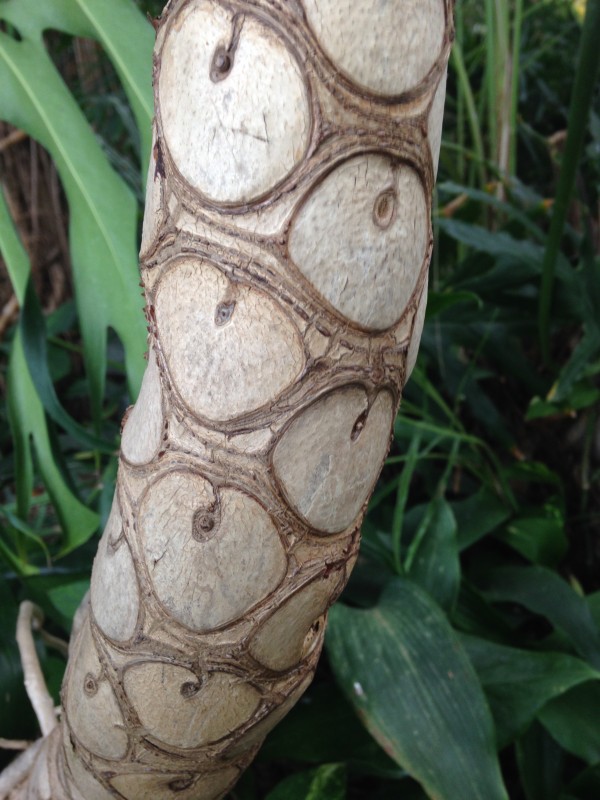 In nature, there are many examples of trees and plants that bend. Most obvious, of course, is heliotropism–movement towards the light. But, if we look closely, we see that the cellular structures of plants and trees organize in circles, spirals, twists and forward folds and back bends in response to tension, gravity, and other forces. Take, for example, the pattern on the trunk of this tree. This intricate mapping of circles, swirls, and criss-crossings, is only possible because of the tension inherent in those spaces. The inside of each enclosure maintains the integrity of the inside, while, at the same time, defining the space that is outside.
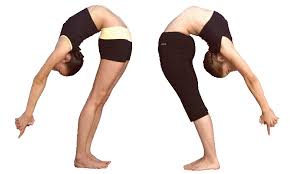 Any potter or architect will tell you that space is an important element of design. Space is not synonymous with empty. When you pick up a bowl, the space inside the curve represents the potential for holding. It may, at that moment, be empty, but there is still space there. Let’s say we fill that bowl with peppermint candies. The space is filled with the candies, but it is still space. When we practice yoga asana with this perspective in mind, we can get curious about the space that exists in our bodies and how to create more space. What are the spaces that are empty? Where are the crowded spaces? What can be moved or re-distributed? What are the solids providing something to push against? Where are the natural bends and folds? Look at the women in extreme back-bending postures. These are extreme examples being used here not to suggest that your back-bend should look like this, but because these images invite us to examine the space around the body more easily. Where is the space? The space is actually beneath the spine. While many of us refer to back bends as “heart-openers”, the anatomic reality of these shapes are that our hearts are pressed up into the chest cavity with the spine rising up to meet it. The space underneath the spine is expanded and opened.
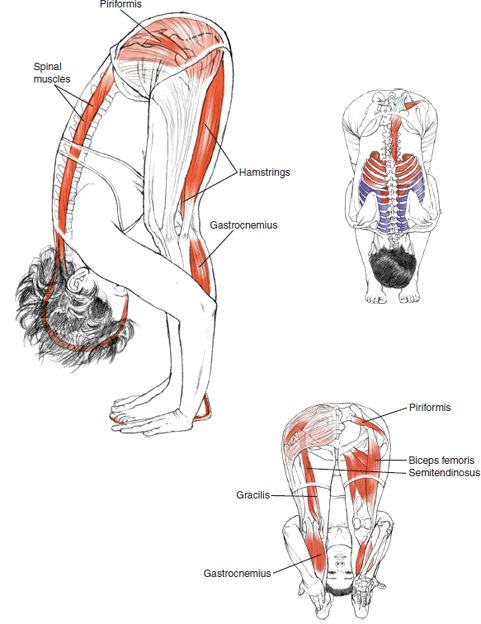 In a forward fold, the space for the heart expands and the spine rises above as it pulls back and away from the heart. To give the heart the most room, we allow the spine to round, creating the space at the heart center. We can breathe there, into the space, and feel the opening from the heart to our legs, and even further into the earth. Experiment with this space you create in front of and behind the spine. Where does the space go when you release the yoga pose? Actually, it is always there, but your shifting the contents of the space allows you to play with what is the container and what is contained.

-

- Radiant Walks 2017-2018






I invite you to not only think about the shape that your fold or bend takes you in, but how the space around you shifts. Explore these images of bends and folds in nature, not just the way that the shapes appear, but how the shape both creates and consumes space. Whenever I guide students through savasana, the final relaxation at the close of most yoga classes, I always suggest that students release any tension that they might be holding in the space directly around their body. It’s amazing how much release happens after that suggestion!
Written by Sharon Fennimore, a rogue anthropologist, yogini, and global doula based in Pittsburgh, Pennsylvania.
 You might not think of yoga when you consider ways to cool down. As a matter of fact, with the proliferation of hot yoga, you may only think of yoga as an activity that is meant to generate heat. But, yoga and meditation offer a variety of ways to help balance your experience of heat.
 #1: Sheetali Pranayama
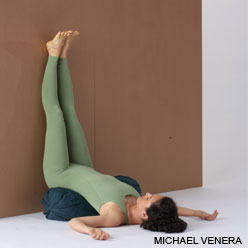 #2: Legs Up The Wall Pose (Viparita Karani)
 Start with your support about 5 to 6 inches away from the wall. Sit sideways on right end of the support, with your right side against the wall (left-handers can substitute “left” for “right” in these instructions). Exhale and, with one smooth movement, swing your legs up onto the wall and your shoulders and head lightly down onto the floor. The first few times you do this, you may ignominiously slide off the support and plop down with your buttocks on the floor. Don’t get discouraged. Try lowering the support and/or moving it slightly further off the wall until you gain some facility with this movement, then move back closer to the wall.
 Your sitting bones don’t need to be right against the wall, but they should be “dripping” down into the space between the support and the wall. Check that the front of your torso gently arches from the pubis to the top of the shoulders. If the front of your torso seems flat, then you’ve probably slipped a bit off the support. Bend your knees, press your feet into the wall and lift your pelvis off the support a few inches, tuck the support a little higher up under your pelvis, then lower your pelvis onto the support again.
 Lift and release the base of your skull away from the back of your neck and soften your throat. Don’t push your chin against your sternum; instead let your sternum lift toward the chin. Take a small roll (made from a towel for example) under your neck if the cervical spine feels flat. Open your shoulder blades away from the spine and release your hands and arms out to your sides, palms up.
 Keep your legs relatively firm, just enough to hold them vertically in place. Release the heads of the thigh bones and the weight of your belly deeply into your torso, toward the back of the pelvis. Soften your eyes and turn them down to look into your heart.
 Stay in this pose anywhere from 5 to 15 minutes. Be sure not to twist off the support when coming out. Instead, slide off the support onto the floor before turning to the side. You can also bend your knees and push your feet against the wall to lift your pelvis off the support. Then slide the support to one side, lower your pelvis to the floor, and turn to the side. Stay on your side for a few breaths, and come up to sitting with an exhalation.