
Satya is one of the most complicated of the yogic ethical principles. It is translated as “truth” in many texts, but truth is, in and of itself, a construct of culture. For example, I may hold as “truth” in my Quaker faith that everyone has the light of God in them (no matter behavior or evidence that seems to prove otherwise), while others may have very different ways of looking at the concept of Holy Spirit or the concept of the divine. Am I telling the truth when I pray in this way? Are the other understandings of the relationship between humans and the divine the NOT-truth? And, how can we relate this use of the word “truth” when describing a commitment of faith to asking a person we work with if they are the ones who ate our yogurt in the shared refrigerator? In the case of the yogurt, it could be seen that this is completely different. Our colleague either ate our yogurt or they didn’t. But, maybe when they answer us it turns out that they, in fact, had brought the same brand and flavor of yogurt to work and assumed the one they ate was theirs? Maybe your yogurt got pushed to some dark corner of the refrigerator and you just assumed someone else ate it? Maybe this colleague was hungry and didn’t have any food, forgot their wallet at home, and in desperation chose to eat a yogurt in the refrigerator and since your name wasn’t on it they had no way to ask for permission or to know who it belonged to? Do their personal circumstances change the “truth” of the stealing?
I am in a situation right now in which there is a great deal of confusion and a story is being told about me that does not resonate with me as true–at all. It seems so fantastical that it’s almost impossible to defend myself. I don’t think that this is a rare experience and that most humans have found themselves at one point or another feeling a profound dissonance between what is true for them and how another person is perceiving the situation. It seems clear to me that the root of this concern can’t be solved by discovering THE truth because each person involved is secure in what they believe to be true. Just as I can’t be shaken from my version of the story, my role in it, and my intentions, neither can the other people involved.
In this way, I invite myself to practice and see “satya” as a form of grace. How can I stand in my own satya with confidence AND compassion? Unless I can soften the edges of my narrative, then resolution remains near impossible. And, I must remain anchored in my personal commitment to peace and non-violence above all else. If I truly believe in the infinite nature of the life of spirit, then I must accept that a resolution may not be possible in this lifetime, but I can always choose peace in any moment. The ethics of yoga are part of the practice. Therefore, I challenge myself even in this most difficult of moments to practice “satya” as a way to extend grace into my life and the lives of others.
When I did my first yoga teacher training program, it was at a studio called “Satya” in Brooklyn that was sold before I even finished the program and became some other yoga studio and now it is even some other yoga studio (or maybe a falafel stand…..things change!). In a 200-hour teacher training program that is registered with Yoga Alliance, the curriculum must include a certain number of hours studying Patanjali’s Yoga Sutras. I dutifully memorized the yamas and the niyamas and promised as a teacher and student of yoga to bring satya into my work and my life. But, truth isn’t just the opposite of telling lies. The pursuit of truth is a process and a yoga practice of its own. It turns out that satya is one of the most challenging aspect of practice and to bring into life off the cushion or mat.
A term that has come into use in the past few years is “fake news”. When the truth is inconvenient, then the person who wishes it wasn’t the truth can point at it and declare it to be “fake”. All the people who agree that if it really was true then it would be a terribly inconvenient and damaging situation can then get behind that person and say, “Yep, it’s fake all right. FAKE!” (It turns out that exclamations and the confidence behind them make the statement even more powerful.). But, there are all these other people who are hurt by the negation of what they feel is the obvious. Uh….we all saw the video/heard the tape/saw the picture of the body of the dead baby washed onto the shore……what do you mean FAKE? Someone had to clean that blood up, someone had to spend years healing their body and spirit after having their body grabbed in an unwelcome way, someone lost their retirement, someone’s child is irreparably hurt by lead poisoning because they drank the water that flowed through their kitchen tap, and someone had to wrap that baby’s body in a sheet and bury him. In these situations, all these someone’s have had their lives completely altered by a truth that other someones are convinced is completely fake. And, we can feel however we feel and get behind whatever truth resonates with us, but we can’t get justice for the victims this way. There is no justice without grace.
In his book “Inner Engineering: A Yogi’s Guide to Joy” by Sadhguru, he instructs us to consider the yogic path as one of experiment.
“The yogic path is not a path of inherited belief; it is the path of experiment (page 69).”
As a spiritual scientist, I would suggest that in our commitment to practice as experiment that whenever we find ourselves feeling committed to a certain satya that we ask questions as an expression of curiosity:
- Where do I feel this “truth” in my body? What emotions and state of mind are inspired by this “truth”? As Rachel Carson suggested in The Sense of Wonder, “It is not half so important to know as to feel.” Does this truth resonate in my spine? Does this truth inspire me? Does this truth make me feel angry or fill me with regret? Does this truth open my throat or give me a pain in my neck? Is this truth opening my heart or making me feel tight and restricted?
- How does this truth impact others? Since we are all “one” and interconnected in both the obvious and many unknown ways, it is important to explore with curiosity how this truth is working in our daily lives. Does this truth improve the quality of my relationships with my co-workers? Does this truth hurt anyone in their body or on an emotional/spirit level? Try to ask questions without judgement. Just because a truth hurts other people doesn’t make it false, but it creates some space around the fact of it just to ask questions and to explore the entire picture. Therefore, in questioning this impact on others, allow all the answers to be felt in your body and known to your heart-mind.
- Have you ever felt in a different way about this truth? Allow yourself to acknowledge if there have been times that something different may have be true for you or just to see that this truth has evolved over time. If there has been change over time, what has inspired the change? For example, maybe you have never trusted doctors….they are just out to get your money, they prescribe medications unnecessarily, they don’t really care about their patients, etc. But, in the past year, your parent became very ill and you found their physician to be a healing force for good. Your parent’s condition improved and you had excellent communication with the doctor and felt cared for and listened to. Well, it doesn’t mean that their aren’t bad doctors out there, but now you have had an experience that has shifted your truth to allow for a truth where SOME doctors are honest and compassionate and worthy of your trust. Don’t feel ashamed if you find that the truth has shifted over time. It is important to explore and be curious without judgment.
- Is there a version of this truth that is an expression of grace in my life and the lives of others? Is there a version of this truth that allows for the humanity to be honored or dignity extended? If there isn’t a version of this truth that expresses grace, then I suggest that you question if it truly is “satya”. For, any spiritual truth must also be grace. If a truth diminishes a person or group of people and strips them of their integrity, their spirit, their heart, or their ability to move freely and express their karma and dharma in this lifetime, then it is unlikely to be true. If you are holding a “truth” about yourself that holds you back from your full expression, then it is unlikely to be “satya”. Sometimes, the least honest truths we hold are the ones we hold about ourselves and then project onto others.
In the forward to the second edition (1989) of M.C. Richards’ “Centering: In Pottery, Poetry, and the Person”, Matthew Fox refers to centering as “the process of righting things, of making justice happen (xiii).” In our meditation and mindful movement practices, we center and calm ourselves. The more centered we are, the more likely that we can explore a truth to come to a place of genuine satya. Standing in mountain pose, we can take a deep breath and feel the soles of our feet reach infinitely through space and time into the ground beneath us (Is it really solid? Who is holding who up?) and the crown of our heads expanding infinitely into space on our out breath (Where do we end and begin? What am I expanding out into?). In that moment, the truth is the breath. The satya of breath is always there for us to ground in, until, it isn’t. It seems important, while we have breath, to keep taking this opportunity to find grace and extend it to as many other people as possible. Everything else can just fall through our open fingers, but an investment in satya will always provide high return.
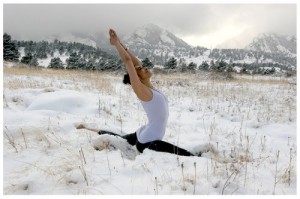 You might not think of yoga when you consider ways to cool down. As a matter of fact, with the proliferation of hot yoga, you may only think of yoga as an activity that is meant to generate heat. But, yoga and meditation offer a variety of ways to help balance your experience of heat.
 #1: Sheetali Pranayama
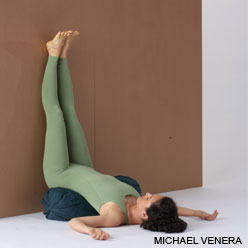 #2: Legs Up The Wall Pose (Viparita Karani)
 Start with your support about 5 to 6 inches away from the wall. Sit sideways on right end of the support, with your right side against the wall (left-handers can substitute “left” for “right” in these instructions). Exhale and, with one smooth movement, swing your legs up onto the wall and your shoulders and head lightly down onto the floor. The first few times you do this, you may ignominiously slide off the support and plop down with your buttocks on the floor. Don’t get discouraged. Try lowering the support and/or moving it slightly further off the wall until you gain some facility with this movement, then move back closer to the wall.
 Your sitting bones don’t need to be right against the wall, but they should be “dripping” down into the space between the support and the wall. Check that the front of your torso gently arches from the pubis to the top of the shoulders. If the front of your torso seems flat, then you’ve probably slipped a bit off the support. Bend your knees, press your feet into the wall and lift your pelvis off the support a few inches, tuck the support a little higher up under your pelvis, then lower your pelvis onto the support again.
 Lift and release the base of your skull away from the back of your neck and soften your throat. Don’t push your chin against your sternum; instead let your sternum lift toward the chin. Take a small roll (made from a towel for example) under your neck if the cervical spine feels flat. Open your shoulder blades away from the spine and release your hands and arms out to your sides, palms up.
 Keep your legs relatively firm, just enough to hold them vertically in place. Release the heads of the thigh bones and the weight of your belly deeply into your torso, toward the back of the pelvis. Soften your eyes and turn them down to look into your heart.
 Stay in this pose anywhere from 5 to 15 minutes. Be sure not to twist off the support when coming out. Instead, slide off the support onto the floor before turning to the side. You can also bend your knees and push your feet against the wall to lift your pelvis off the support. Then slide the support to one side, lower your pelvis to the floor, and turn to the side. Stay on your side for a few breaths, and come up to sitting with an exhalation.