Category: General

Pittsburgh Yoga and Meditation Classes

ViparitaKarani_248Old School Yoga

Mondays and Fridays 9:30 to 10:30 AM
$10 cash or check

Old School Yoga is a classic Hatha yoga class designed to build strength and flexibility in the body while calming the spirit and mind.  No bells, whistles or fancy pants and no experience required.  We start with deep breathing and move through a sequence of yoga poses.  Practice ends with a deep relaxation.  Please check events on Facebook page to make sure class is being held.  All classes are held at Mookshi Wellness Center (401 Biddle Avenue, 2nd Floor above Biddle’s Escape Coffee Shop).  Wear comfortable clothing.  All props, including yoga mats, are provided.

800153_thumbnailSeated Meditation

Mondays 10:45 to 11:30 AM
$10 cash or check

This is a seated meditation practice that begins with a simple breathing exercise and then a guided relaxation and meditation designed to build compassion.  No experience required.   Please check events on Facebook page to make sure class is being held.  All classes are held at Mookshi Wellness Center (401 Biddle Avenue, 2nd Floor above Biddle’s Escape Coffee Shop).  Wear comfortable clothing.  If you have a meditation cushion, please bring it.  If not, we have props for you to use at the center.

cropped-Kissing-Baby.jpgMamma Yoga

Fridays 10:45 to 11:30 AM
$10 cash or check

This is a gentle yoga practice for expectant and postpartum moms (sure, bring your baby!) designed to relieve tension and build strength and tone to the pelvic floor.  For pregnant mammas, this is an important time to build pelvic floor tone and for postpartum moms building the pelvic floor is an important first step for recovery of core strength and tone.  If you foster your bambino or have adopted or you are the “other mom”—OF COURSE you are welcome too!  If babies are in attendance, we will do a few minutes of yoga and fun things for them to make them feel a part of the class.  If your baby is one or older, you may want to consider making it a morning off for mamma and drop them off at PMO (Parents Morning Out) up the street (Call me 412-855-5692 if you need more information about PMO).Please check events on Facebook page to make sure class is being held.  All classes are held at Mookshi Wellness Center (401 Biddle Avenue, 2nd Floor above Biddle’s Escape Coffee Shop).  Wear comfortable clothing.  All props, including yoga mats, are provided.

Registration Fall Classes 2013

All group classes are $136 for 8-sessions in the fall semester.  All private sessions are $100 and may be shared by up to two adults.  The fall semester is from September 23, 2013 through November 22, 2013.  All group and private sessions are held in Regent Square at Mookshi Wellness Center.  This is on the 2nd floor above Biddle’s Escape Coffee Shop at 401 Biddle Avenue.  Payment options, including requests for alternative payment plans or arrangements,  are explained on the registration form.  If you wish to pay for fall tuition using PayPal, the PayPal options are listed on the bottom of this page.  If you have any questions about classes or registration, please call Sharon at your convenience (412) 855-5692.

REGISTER HERE


MONDAY
9:30 am Yoga/All Levels (6-8 spaces available)
10:45 am Meditation/All Levels (8-10 spaces available)
4:30 pm  Yoga/All Levels (6-8 spaces available)
5:45 pm Yoga/All Levels (6-8 spaces available)
7:00 pm Private Session (1-2 spaces available)
WEDNESDAY
4:30 pm Yoga/All Levels (6-8 spaces available)
5:45 pm Prenatal Yoga (6-8 spaces available)
7:00 pm Private Session (1-2 spaces available)
8:15 pm Meditation (8-10 spaces available)
FRIDAY
9:30 am Yoga/All Levels (6-8 spaces available)
10:45 am Mom & Baby Yoga (6-8 spaces available)
12:00 pm Private Session (1-2 spaces available)

 PAY 8-Class Series Tuition of $136 HERE

PAY 5-Class Drop-In Package Tuition of $100 HERE

PAY 1-Single Private Session Tuition of $100 HERE


Old School Yoga

ViparitaKarani_248I just happened upon this wonderful Blog Post By Charlotte Bell and her ideas about Old School Yoga resonated with me so clearly that I wanted to share the post with you.  All these years I haven’t known what to call my style of yoga and I’ve struggled with variations on the theme of mindfulness, but now I think that I too am practicing and teaching Old School Yoga!  A practice to open the heart, to relax, to rejuvenate, to create space…….that’s my practice and that is what I share with you.

Are you looking for Old School Yoga classes in the Pittsburgh region this fall?  I’m putting together my teaching schedule and small groups and would love to work with you!  Please fill out this form and I will contact you when I have a class that meets your scheduling needs.  Note that while this form is just “up here” on my website, your answers are completely confidential.  I don’t have any “staff” and am the only person who reads the responses.  Once you submit, the form is cleared and no one sees what you entered but me.

Fill out my online form.

Postpartum Nutrition

Thank you Lisa Bartle for this guest post:


Post Partum Nutrition For New Moms: Taking Care Of You, So You Can Take Care Of Baby

A new mom is someone who really needs to be taken care of. She’s done an amazing job of bringing a new life into the world. Nourishment of the baby begins in-utero and what the mother takes in during her period of pregnancy will affect not only her health but that of the baby once it is brought into the world. Once the birthing process has taken place, the new mom needs to know that she can rely on good food, proper hydration and plenty of rest so that she is able to face up to the challenges of dealing with the new addition to the family. If at all possible, it helps to have a strong network of family and friends around who can help out and make sure that needs of both mom and baby are met every single day for the first few weeks at least.

Postpartum considerations

There are many aspects of the physical and mental health of new moms that need to be taken into consideration at the postpartum stage of child rearing. Thinking about the mind, body and spirit as a whole means recognising the fact that there will need to be a sufficient period of recovery that allows the mom to recharge and bond with the baby. Part of this bonding process relates to lactation and the ability to produce milk to wean the baby on. According to principles of Ayurveda, a period of around forty two days should be given to allow these natural processes to occur. This should be extended by another ten days for any mom who is recovering from a C-Section or any other form of postpartum surgery. Good health is vital and the new mom will have many things to think about pertaining to her own situation and the baby too. Aside from considering the fundamentals of nutrition it can also help to have a chat with a physician about appropriate pain relief and medications (particularly if there has been a surgical birth), to consider some of the different methods or forms of birth control, whilst in recovery from the labor itself and whilst the body adjusts to all the changes it has gone through. Finally, there is the need to make sure there is someone professional to talk to should there be any concerns or issues relating to the mom’s physical or mental health.

Foods for new moms

It’s important to recognise that every mom’s needs will be different, but that optimum nutrition is gained from eating fresh foods, that are easy to digest and offer a great range of nutrients that will help to relax the mind and body and also encourage breast milk to flow. It’s important to remember this is not the time to go on a fad diet to try and drastically shed the baby weight. Instead, think about eating foods that are rich in essential fatty acids, zinc, magnesium, calcium and B vitamins such as:

  • Lean chicken and turkey and small quantities of lean red meat
  • Salmon, mackerel, halibut and other oily fish
  • Healthy fats such as olive oil, flax seed oil, cod liver oil or even the oils that come from fruits like avocado
  • Pulses – such as lentils, kidney and cannelini beans
  • Fresh greens – spinach, kale, lettuce, cabbage
  • Fruits that are rich in iron and fiber – figs, dates, sultanas, raisins
  • Fresh fruits in season
  • Sweet potatoes
  • Nuts and seeds – almonds, walnuts, pumpkin seeds
  • Whole grains – brown rice, quinoa, oats
  • Nut milks, yogurt and buttermilk
  • Pure water, herbal teas
Meals that are based round a nourishing ‘one pot’ idea can be of benefit in that they are easy to prepare, cook themselves and mean there is little in the way of clearing up. Soups and stews based around the meats, vegetables and pulses mentioned above would be great.

Foods to try and avoid

  • Anything heavy, greasy, fatty or deep fried
  • Processed meat products
  • Fast food
  • Ready or convenience meals
  • Highly spiced and seasoned foods
  • Sodas (diet or otherwise)
  • Caffeine

The list of foods to avoid, in truth, should be something that is adopted by people generally and not just new moms, but taking this approach and investing in a diet that is rich in lean protein, in nutrient and iron rich greens and which includes healthy fats is one that will not only encourage healthy lactation, but one that will help to keep the mom’s blood sugar steady and the brain calm. Eating regularly, every three to four hours will ensure that the body does not go into starvation mode or that the point of being over hungry and therefore likely to over-eat doesn’t happen.

Creating a safe routine is so especially important at this time and set times for meals are a great thing to put in place and keep in place, to provide a sense of calm and comfort at a time when things may seem a little out of kilter and strange. Putting a little structure and routine into life can really help, if there are feelings of being unsettled and unsure.

Finally, when thinking about the post partum period as a whole (and not just in terms of nutrition) certain words can help to provide a focus.

Keep things:

  • Slow
  • Steady
  • Warm
  • Relaxed
Post partum nutrition need not be something that feels like it is a chore or a special ‘diet’ that is boring or unhealthy. It can be inspiring, health giving and uplifting.

Consider it Solved!

I’m so excited about fall that I’m offering an amazing Back to School special between now and September 4, 2013:

Discount Single Sessions

Mini-Sessions for Solving Big Problems!

From now through September 4th, schedule a single phone coaching session for 1/2 the regular price.  That’s right, for just $75 and one hour of your time we can work together to find a solution to whatever is bothering you the most RIGHT NOW.  I’m so positive that we can solve one of your problems in an hour that these sessions are 100% guaranteed.  Within 1-week or your mini-session, if you follow-up our session by completing all the exercises and practices suggested in the session and feel that your problem has not been greatly alleviated or solved to your satisfaction or you have significant regrets about the money spent on the session, you can request a FULL REFUND.

What kinds of problems can we solve in a mini-session?  Well, when you schedule your session you will receive a mini-session intake form.  On this form you will need to clearly identify the thing that is bothering you the most right now and provide me with some details so that, when we start the session, we can get right to work.

Sample Problems that I Have Been Able to Help Solve in a Single Session

  • A new mom that feels panic when she drops her baby at daycare in the morning

  • A woman wondering when to schedule her final IVF cycle attempt or whether to try IVF at all

  • An adult with a great fear of flying that must get on a plane to attend a special event

  • A single chronic health complaint: insomnia, feeling overwhelmed, irregular periods, neck & shoulder tension, etc. 

  • You have a job offer in a different city or country and wonder whether or not you should take it

  • You have recently been diagnosed with cancer and feel scared and overwhelmed

  • Stress is taking a toll on your health and quality of life, but you don’t know how to relax

  • You are pregnant and find yourself more than halfway through the pregnancy and not sure that you like your doctor anymore

  • You are pregnant and your mother in law wants to be at the birth and you don’t want her there

  • You are terrified wondering what contractions feel like.  Will you be able to manage in labor?

  • You have an important presentation to make for work, but have a terrible fear of public speaking.

  • You wish you had a daily meditation practice, but you don’t know how to start

  • You had a baby six-months ago and every time you cough or sneeze you still pee a little

I’m only human, and, thus, confined by the same 24-hours in a day that you are—so there are a limited number of mini-sessions available.  In order to schedule your session, just send me an e-mail (sharon@yogamatrika.com) and in the e-mail provide three, 2-hour time slots between now and September 4th that will be ideal for you.  The earlier you schedule, the more likely that your slots will be available.  I will respond with an e-mail confirming one of the times listed, link to payment information and the session intake form.  You send me the intake form at least 24-hours before our session by e-mail and Bob’s Your Uncle!  If you don’t “do” e-mail, then please call me at (412) 855-5692 to inquire.  It may be more challenging to reach me by phone, but if that is your preference, you can expect a return call within 2-business days.

Fall is coming and I want you to make a fresh start by helping you solve your greatest worry, concern, fear or problem before it stops you from enjoying the season.  Do you remember that “new beginning” feeling you had every year when school started?  Not only do I want to help you solve a problem, but I’d like to get you back to school by offering FREE tuition to my Four Noble Truths Course (value $25) to everyone who buys one mini-session during this special.


Do you just need a good laugh? (Adult Content & Language)


Spread Your Lips for a Better Birth

I have a prediction that this may become one of my most popular blog posts.  Just wanted to put that out there right from the start.

Ina May Gaskin has noted that:

Early in my midwifery career, I observed another fascinating relationship pertaining to the Law of the Sphincter.  I noticed a strong connection between the sphincters of the mouth/throat and those of the cervix and yoni.  A relaxed mouth means a more elastic cervix.  Women whose mouths and throats are open and relaxed during labor and birth rarely need stitches after childbirth. (Gaskin, pg. 178)

Research now shows that what Ina May Gaskin observed is also supported by actual anatomical features of the mouth and cervix.(As of 4.16.16 it has come to my attention that this link no longer works.)

Cervix and vocal fold tissue behave similarly in smear tests.

Vocal Folds

Vocal Folds


Cervix

Cervix

So mamma, what can you do to keep all your lips relaxed from your mouth to your perineum?

1. Keep people with you in labor who can help you laugh, remind you to sing and chant and keep your face as relaxed as possible.  Now, anyone who has been in labor or attended to a woman in labor knows that demanding that someone “relax your mouth” is not only ineffective, but it is not respectful.  The best thing to do is help the laboring woman remember by doing a mouth relaxation exercise yourself where she can clearly see you.  Watching YOU relax YOUR mouth will remind her to do the same.

2. “Horse Lips”—-flutter the lips on your mouth during contractions.  It not only helps regulate breath and manage pain, but it is kind of hilarious and fun too.  Practice when you are relaxed and in private while pregnant and you will automatically do it while in labor.  It may feel silly when you aren’t in labor, but you will reach for this amazing trick when the going starts to get strong during labor without question.

3. Sounding: The seed syllable to chant for the navel center is RAM.  Sit in your strength during labor or stand or dance and chant RAM deep from the basin of your pelvis.  In order to pronounce the “RA” part of the chant you have to make an open oval of your mouth.  Then, when you go to close your mouth to “M” you hum a bit and the vibration relaxes your lips, tongue, mouth and whole face.

4. Did I mention laughing?  Sure, if you’ve never been in labor you might be thinking that I’m one of those folks that insists that labor doesn’t hurt (OK–I KNOW that some people have orgasmic births and some never feel pain, but that isn’t my personal experience and I don’t think you should count on it for your experience.)  But, it is FUN!  You are having a baby and not a train wreck after all.  Let your support team plan to keep things light and smile at you often so you can remember to smile back.

5. Kissing?  I’ve got to be honest with you here.  Personally, I get super sensitive about my personal space while I’m in labor.  The idea of someone blocking my precious airways with their mouth by kissing me and being all up in my face and my space was not attractive.  Not in the least.  But, you know, if you feel like kissing while you are in labor, it definitely wouldn’t hurt.  And, well, it’s really your last chance to make-out and not have to worry about getting pregnant for a while……..so, might as well live it up!

To summarize, it’s important to keep your mouth open and relaxed so your perineum and cervix will relax and open to make way for baby.  You can do this effectively by singing, laughing, kissing, fluttering your lips with “horse lips” and sounding deeply from the basin of your belly or chanting RAM or OM if you are open to these sounds.

dreamstime_xs_19885848

Want to know how prenatal yoga can help you feel great during pregnancy and help you prepare for birth?  CLICK HERE


Did you super love these fascinating labor tips and information on the anatomy of labor and birth?  Well, join me for regular updates and be the first to see articles and find out about FREE pregnancy and postpartum events!


RESOURCES:

Ina May Gaskin
Ina May’s Guide to Childbirth.

Cervical and Vocal Fold Study

Beautiful Cervix Project


This post was written by Sharon Fennimore Rudyk, MA, E-RYT, DONA Trained Birth Doula and mamma to two lovely littles.  I’m based in Pittsburgh, but due to the incredible power of the internet, I work with expectant moms and their partners all over the world to prepare for birth.  You can call me for a free phone consultation (412) 855-5692 OR send an e-mail: sharon@yogamatrika.com.  I’d be so honored to be a part of your pregnancy and birth!  https://www.yogamatrika.com

Birth Doula Services

Please note that this is an older blog post from two-years ago.  I am not currently taking birth doula clients. I recommend:


  1. Shining Light Doulas
  2. Ola Olabasi, Ola’s Herbs

I am able to offer birth and postpartum doula services in the City of Pittsburgh to a limited number of women and families each year.  I give priority to my prenatal yoga, birth and coaching students and clients who wish to invite me to support them during their birth and the weeks after their birth.  It is such an honor and joy to provide continuity of care.  I also consider attending births for women that may need or desire either a doula with Mandarin Chinese language skills, yoga and meditation based pain management techniques or who are planning a family-centered cesarean birth.  I primarily prefer to attend hospital or birth center births.

For postpartum care I can work with families that reside within the City of Pittsburgh only and am not available for overnights.

As I am only able to accept a small number of births to attend each year, it is very important for you to call me as soon as possible to reserve your birth month: 412-855-5692

If I am not available to reserve for your birth or postpartum period, I will always return your call and we can talk about other options.

Insurance and Flexible Spending Account Coverage

Some insurance companies cover doula services.

You may also submit receipts to your medical expense FSA (flexible spending account) to help reduce your costs. Local doula clients have been reimbursed by all known flexible spending accounts.

Doula services are also tax deductible.


How to get Reimbursed for Doula Services

1. Pay your doula in full for her services.

2. Get a receipt from your doula. The receipt will include the following information:

  • the doula’s identifying information
  • the diagnosis code (V22.2, intrauterine pregnancy)
  • the CPT code (99499, Evaluation and Management Services – Labor Support)
  • the date and location services were provided
  • the mother’s name
  • total charge for services
  • dates and amounts of payments
  • payment method

3. Submit the receipt with a claim form to your insurance or flexible spending account company’s claims department.

4. Within a month, you should receive a response. If you receive a letter denying the claim, do not be discouraged. Prepare a new packet to resubmit to your insurance company for a secondary review, and copy everything in the packet to the insurance company’s CEO explaining why you feel services should be covered (and be sure to point out how much money the insurance company saved because of the services your doula provided). In this re-submission packet, you should include the following:

5. Be persistent. If your claim is denied upon your initial request, call and ask why. If they refer you to your policy, ask them to specify exactly what clause and what wording in your policy excludes doula services.

6. Whether you are reimbursed or not, please tell your doula what kind of response you got from your insurance company. Each time someone requests reimbursement, it tells the insurance companies that this is an important service. Since doulas save insurance companies money, they may consider requests more carefully in future. If you are reimbursed, this is good news for doulas and we always want to know!

[Thank you to the Corvallis Doula Network for providing this very informative process for obtaining insurance reimbursement for doula services and for reminding us that it is important to pursue reimbursement even if you don’t think that you are covered for this service.  Your attempt to obtain reimbursement sends a very important message to your insurance company that you would like them to make the health of women and children a priority.]


Fertility

NOTE: this is a dated blog post that describes services and packages that are no longer available.  If you are interested in my optimum fertility and reproductive health services, please follow this link to the current packages. 

Optimum Fertility

dreamstime_xs_5551756


Reproductive Health and Fertility Coaching


Irregular Periods? PMS? Moody? Bloated? Doubled over and missing out on activities and work due to cramps, migraine headaches or back pain?  Does your period just go on and on and on?  Is “heavy” flow an understatement?

PCOS? (Poly-cystic Ovarian Syndrome) Anovulation?  Not ovulating due to low body fat, endocrine disruption or trying to regain fertility after being on birth control pills or other hormone based birth control?

Trying to conceive for over 6-months without a pregnancy?  Miscarriage?  Unexplained infertility?  Considering IVF or other medically assisted reproduction therapy?


There is no reason to suffer!  I offer personalized coaching services where we address your greatest concerns, create do-able action plans for addressing your needs and all the support and confidence you need to improve the quality of your life and reproductive health.  Your action plan is likely to include:

  • Stress Management
  • Diet and Nutrition
  • Meditation and Visualization
  • Mindful Movement, Yoga and Exercise
  • Counseling on finding the best medical care providers, alternative health services and problem solving
  • Learning how to track fertility signs to either prevent or promote conception

Take the first step and call for your FREE phone consultation: 412-855-5692.  During this consultation I will work with you to determine what your reproductive health goals are and offer you an initial evaluation and proposal for our work together.  To give you an idea of the costs for this type of coaching work, here are some examples of coaching packages:

One-Time Coaching Session  $150

Before the session you fill out an extensive intake survey so I know exactly what you need before the call.  During the call we address a singular issue regarding your reproductive health and/or fertility.  You leave the session with an action plan for solving your greatest concern and I will be available to you for unlimited e-mail support for up to one-month after the session.  Our session lasts an hour and a half and is scheduled at your convenience.  You may, if it is part of your action plan, decide to enroll in my menstrual education course which includes detailed information on tracking your fertility signs for $90.  This would make the total cost for improving the quality of your life and finding real solutions to your chronic reproductive health problems for $150-$240.

One-Month Intensive $350

Before the first session, you will fill out an extensive intake survey so I know exactly what you want to work on before our first call.  During this month, you will receive weekly meal plans and nutritional advice and we will have three, one-hour phone sessions during the 4-weeks of your month intensive.  This is most likely for women with a more complex health issue or who are scheduled for an IVF cycle and want a month of support around that cycle.

Six-Month PCOS, PMS, Irregular Cycles or Optimum Fertility Coaching Program  $500

This type of program is for women that have a chronic endocrine or other imbalance that is going to require a longer commitment to nutrition, medication, and lifestyle changes in order to meet their goals.  This program includes enrollment in my menstrual education course and e-mail support for 6-months following the program.


Follow-up sessions are between $50-$100 depending on the type and length of session required.  All coaching programs, including single sessions, come with some period of unlimited e-mail support.

5-Ways to Obtain Balanced and Peaceful Travel with Kids

HeadShot5 Ways to Obtain that Balanced and Peaceful Travel

Guest Post by Kendra Thornton


Traveling with kids can be a little bit hectic, but it is always worthwhile in the end. An open mind, bit of planning, and some flexibility can all but guarantee a balanced, peaceful vacation. Here are five things I always make sure of whenever I travel:


1. Look for Hotels with Extras

Especially when I am travelling with my kids, I like to look for hotels with neat activities they can enjoy. I like using Gogobot to check out neat tips and tricks about hotels and amenities; however, I also like checking out the surrounding area. Maybe we stay in a hotel that is close to Disney World for the kids and close to a yoga studio for mom! The important thing is that my kids can enjoy this vacation just as much as I can.


2. Remember to Stay Hydrated

It’s always important to keep yourself hydrated, especially if you are out in the sun all day. In addition to having a glass of water as soon as i wake up and right before I go to bed, I try to avoid drinking anything with alcohol in it until after my flight.


3. Sleep Is Still Important

Sure, we want to get as much action into our day as possible. But sleep is still just as important to our health as it was back at home. Of course, it can be hard to get used to a new time zone and unwind after an action-packed day. I like to bring my own teas, herbs, and candles with me to help me adjust at night and create my own little room of zen!


4. Try Something New

I like to use my vacation as a way to expand my horizons. Sometimes we like to take comfort in familiar stores or restaurants we find in foreign lands that remind us of home, but I remind myself that I am here to meet new people, learn new cultures, and change up my routine, if only for a week.


“Going new places means being open to trying something new – new food, new clothes, new life style,” says Astanga Yoga teacher Kino MacGregor, “and experiencing different cultures helps open the mind to the possibility that there is more than one way to do things.”


5. Go with the flow

Sometimes, no matter how well we plan things out, something goes wrong. While I like having a schedule to follow, I never let a little bit of rain ruin my vacation. If a storm forces me indoors, or if an attraction I wanted to see is closed for renovations, I take it as an opportunity to challenge myself and find something even better to do.


Remember, your vacation is your time to enjoy yourself. While it’s always good to plan things out and be prepared for what’s to come, it’s equally important to go with the flow and enjoy yourself.


Thank you to Kendra Thornton for this informative guest post!  You can follow Kendra and get more travel tips on Twitter @KendraThornton.  As always, you can count on Sharon Fennimore and Yoga Matrika for the information you need for living your best with young children.

Keeping Cool with Yoga

Top Three Ways to Cool Down with Yoga and Meditation

yogasnowYou might not think of yoga when you consider ways to cool down.  As a matter of fact, with the proliferation of hot yoga, you may only think of yoga as an activity that is meant to generate heat.  But, yoga and meditation offer a variety of ways to help balance your experience of heat.

First, we should explore the concept of “heat” in the context of yoga.  There are many different ways to look at heat and fire in energetic principles, asana/movement, and pranayama/breath.  One approach to heat is to examine the “agni” or digestive fires located in the navel center.  The heat produced during the effort of practicing yoga poses (asana) is designed to clear “energetic” impurities.  An example of an “energetic” impurity might be an emotional block or a mental pattern that is no longer helpful.  This allows energy to move more freely through the subtle body and creates potential where there may have not been any before the block was removed.  The energy of heat and fire is that of purification and “fire is the underlying elemental energy of creativity and accomplishment (Tenzin Wangyal Rinpoche, 44).”  When we are experiencing external heat, it give us an opportunity to connect with this internal element of fire and the power it has to remove obstacles to creative forces.

Sure, clearing impurities sounds good, but I’m going to give you three ways to use specific techniques in yoga and meditation to actually cool yourself down when you are feeling over-heated.  From summer heat to hot flashes to trying to cool your head and heart after an argument, these techniques are tried and true cool down favorites:

sheetali (1)#1: Sheetali Pranayama

The word “sheetali” means cooling in Sanskrit, it is taken from the original word “Sheetal” which is soothing or cold.  This breathing exercise (SOURCE):

  • calms the mind and reduces the fight-flight response
  • cools body and mind and lowers blood pressure (so if yours is low to begin with, be careful)
  • effective in reducing hyperacidity and ulcers
  • in the Hatha Yoga Pradipika, Swami Swatmaram says that a person becomes young and attractive by practicing this exercise (cool down AND get young and attractive—BONUS!)
  • gives control over hunger and thirst
  • if you are stressed, just 5 minutes of Sheetali breath will calm you

In this pranayama the tongue is rolled in a specific manner as shown in figure. But many people can not roll their tongue in this fashion. For these people alternate Sitkari Pranayama gives very similar effects.  In Sitkari Pranayama, you draw air in through your teeth and exhale through your nose. Sitkari means “hissing breath” and is named after the sound made when you draw air through your teeth.  Teeth hissing or Sitkari refers to the sound that is made when air is drawn in through the front teeth either slightly opened or tightly closed, with the tip of the tongue regulating the pressure of air and sound. This technique refers only to breathing in, while exhalations take place normally through both the nostrils.

How to do it*:

  • Beginners can start with deep breathing practice in sitting position
  • Then start inhaling through mouth by rolling the tongue, make sure that the air passing in is cooled via tongue.  If you can’t roll your tongue, then follow the instructions given above for Sitkari or “hissing breath”.
  • Initially 4 seconds inhale through mouth while rolling the tongue and exhale for 6 seconds through both nostrils, this can be practiced for about 5 minutes.

*Note: it’s really best to learn pranayama from a teacher and then practice on your own.  If you ever feel uncomfortable, then stop and return to your normal breathing pattern.  It is very important that you try not to strain while practicing pranayama—it should feel calm and never like you are holding your breath or not getting enough breath.  This exercise can lower blood pressure, so if you already have low blood pressure, please be careful.  If you have any questions at all about whether or not this is safe for you, please check with your doctor or yoga instructor.  These instructions are provided for informational use only.
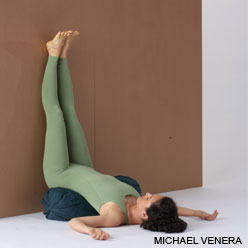
ViparitaKarani_248#2: Legs Up The Wall Pose (Viparita Karani)


The instructions for this pose are given so clearly online by Yoga Journal, that I’d like to direct anyone who needs full and complete instructions, contraindications and information about this pose to Yoga Journal.  

Please note that if you have very tight hamstrings, acid reflux problems or if being upside down this intensely just doesn’t feel right to you, then you can modify this pose by lying down and putting your legs up on a couch or chair.  Please remember that discomfort causes stress.  If you experience discomfort in this pose or in attempting to do this exercise, immediately stop.  The best thing is to consult with a yoga teacher in your area and learn how to do this pose in a way that is right for you.  A small investment in a private session will give you a practice you can use for stress relief for your whole life.

Step by Step

The pose described here is a passive, supported variation of the Shoulderstand-like Viparita Karani. For your support you’ll need one or two thickly folded blankets or a firm round bolster. You’ll also need to rest your legs vertically (or nearly so) on a wall or other upright support.

Before performing the pose, determine two things about your support: its height and its distance from the wall. If you’re stiffer, the support should be lower and placed farther from the wall; if you’re more flexible, use a higher support that is closer to the wall. Your distance from the wall also depends on your height: if you’re shorter move closer to the wall, if taller move farther from the wall. Experiment with the position of your support until you find the placement that works for you.

Start with your support about 5 to 6 inches away from the wall. Sit sideways on right end of the support, with your right side against the wall (left-handers can substitute “left” for “right” in these instructions). Exhale and, with one smooth movement, swing your legs up onto the wall and your shoulders and head lightly down onto the floor. The first few times you do this, you may ignominiously slide off the support and plop down with your buttocks on the floor. Don’t get discouraged. Try lowering the support and/or moving it slightly further off the wall until you gain some facility with this movement, then move back closer to the wall.

Your sitting bones don’t need to be right against the wall, but they should be “dripping” down into the space between the support and the wall. Check that the front of your torso gently arches from the pubis to the top of the shoulders. If the front of your torso seems flat, then you’ve probably slipped a bit off the support. Bend your knees, press your feet into the wall and lift your pelvis off the support a few inches, tuck the support a little higher up under your pelvis, then lower your pelvis onto the support again.

Lift and release the base of your skull away from the back of your neck and soften your throat. Don’t push your chin against your sternum; instead let your sternum lift toward the chin. Take a small roll (made from a towel for example) under your neck if the cervical spine feels flat. Open your shoulder blades away from the spine and release your hands and arms out to your sides, palms up.

Keep your legs relatively firm, just enough to hold them vertically in place. Release the heads of the thigh bones and the weight of your belly deeply into your torso, toward the back of the pelvis. Soften your eyes and turn them down to look into your heart.

Stay in this pose anywhere from 5 to 15 minutes. Be sure not to twist off the support when coming out. Instead, slide off the support onto the floor before turning to the side. You can also bend your knees and push your feet against the wall to lift your pelvis off the support. Then slide the support to one side, lower your pelvis to the floor, and turn to the side. Stay on your side for a few breaths, and come up to sitting with an exhalation.

 #3: Pitta Balancing Asana and Diet

Pitta is one of the three main dosha’s (constitutions) in Ayurvedic medicine.  If you are curious about your own constitution, you can take this Chopra Center Quiz!   The Pitta dosha controls digestion, metabolism, and energy production. The primary function of Pitta is transformation.  Qualities of Pitta dosha are: hot, light, intense, penetrating, pungent, sharp, acidic. Those with a predominance of the Pitta principle have a fiery nature that manifests in both body and mind.

Dietary Recommendations (SOURCE):

  • Dairy can be helpful in balancing the heat of Pitta, take milk, butter and ghee. Sour, fermented products such as yogurt, sour cream and cheese should be used sparingly as sour tastes aggravate Pitta. Ghee (clarified butter) is recommended. Find our ghee recipe here.
  • All sweeteners may be taken in moderation except molasses and honey.
  • Olive, sunflower, and coconut oils are the best oils to pacify Pitta. Use less sesame, almond, and corn oil, which are more heating.
  • Wheat, rice, barley, and oats are the best grains to reduce Pitta. Eat less corn, rye, millet, and brown rice.
  • The sweeter fruits such as grapes, melons, cherries, coconuts, avocados, mangoes, pomegranates, fully ripe pineapples, oranges, and plums are recommended. Reduce sour fruits such as grapefruits, apricots, and berries.
  • The vegetables to favor are asparagus, cucumbers, potatoes, sweet potatoes, green leafy vegetables, pumpkins, broccoli, cauliflower, celery okra, lettuce, green beans, and zucchini. Reduce tomatoes, hot peppers, carrots, beets, eggplant, onions, garlic, radishes, and spinach.
  • Pitta types need to use seasonings that are soothing and cooling. These include coriander, cilantro, cardamom, saffron, and fennel. Hotter spices such as ginger, cumin, black pepper, fenugreek, clove, salt, and mustard seed should be used sparingly. Very hot seasonings such as chili peppers, and cayenne are best avoided. Chew on fennel seeds after meals to cool down acid in the stomach.
  • For non-vegetarians, chicken, pheasant and turkey are preferable; beef, seafood, and eggs increase Pitta and should be minimized.

Asana Recommendations (SOURCE):

Asanas that help balance Pitta are those that place pressure on the naval and solar plexus region, in the small intestine where Pitta resides. There should be enough calming poses included to sedate irritation, anger, and intensity caused by Pitta. In general all forward bends, side stretches, twists, backbends that stretch muscles in your stomach will be beneficial.

Here are some suggestions:

– Ustrasana (Camel Pose) – This asana opens up abdomen, solar plexus, and chest, allowing for free movement of energy through these regions.

– Bhujangasana (Cobra Pose) and Dhanurasana (Bow Pose) – Also excellent solar plexus extensions for Pitta. They activate and support healthy thyroid gland function that is responsible for internal temperature regulation and metabolism. A better functioning internal thermostat will make hot weather more bearable.


- Matsyasana (Fish Pose) – as Yoga Journal notes, Matsyasana is the “destroyer of all diseases.” It stretches and stimulates the muscles of the belly and front of the neck; and stimulates the organs of the belly and throat

 Utthita Parsvakonasana (Extended Side Angle) and Trikonasana (Extended Triangle) – are good example of side stretches. Side stretches stimulate the abdominal organs; help relieve stress; improves digestion; and can be used to alleviate anxiety.


- Paschimottanasana (Seated Forward Bend) and Pada hastasana (Hands to Feet) – all forward bends calm the brain and helps relieve stress and mild depression; stimulate the liver, kidneys; improves digestion; soothe headache and anxiety and reduce fatigue
.

–  Meru Vakrasana (Simple Spinal Twist) andArdha Matsyendrasana (Semi Spinal Seated Twist) – all twists stimulate the liver and kidneys, energize the spine, stimulate digestive fire in the belly; and relieve fatigue.


- Supta Vajrasana (Sleeping Thunderbolt or Diamond Pose), Sarvangasana (Shoulder Stand), Halasana (Plow), and Mayurasana (Peacock) – are good Pitta balancing poses, as well.


Love this article?  Looking for more ways to improve the quality of your life through meditation, yoga and mindful movement?  Make sure you sign up for my weekly newsletter so you are the first to receive updates and information.


Posted by Sharon Fennimore, MA, E-RYT, RPYT and DONA Trained Doula:  a yoga and meditation instructor and mind body coach based in Pittsburgh, Pennsylvania.  I offer phone coaching and support and online courses in meditation and professional development.  My e-book, Matrika Prenatal Yoga is available on iBooks, Kindle and a PDF download.   Check out my website for more information!