Tag: embodied anatomy

Buddhist Philosophy and Yoga Anatomy Workshops

These workshops are no longer being held fall 2016. Please check back for future collaborations and check out Mark’s website for his teaching schedule.

Philosophy and Embodied Anatomy Workshops

I am honored to host our guest instructor, Mark Chandlee Taylor, the Director of BodyMindMovement to facilitate the following embodied anatomy workshops yoga students and teachers.  All workshops are held at Mookshi Wellness Center in the Regent Square neighborhood of Pittsburgh.  Sessions begin with an hour of practice and discussion of the required text with Sharon which will be followed by a short break and then three-hours of anatomy with Mark.  All workshops are from noon to 4:00 pm.  I recommend that students obtain a copy of “Awakening of the Heart: Essential Buddhist Sutras and Commentaries” by Thich Nhat Hanh and read both his translations and commentaries in preparation for discussions.  Alternatively, I have provided links below where you can find PDF versions of the required texts.

As space is limited, pre-registration is highly recommended.  Workshops are $45 when you register online.  If you are blocked from online registration, please email Sharon Fennimore with your interest and you will be added to the waiting list: sharon@yogamatrika.com.  If space is available on the day of workshops, you will be warmly welcomed for $60 drop-in tuition.

October 16, 2016 (SUNDAY)
Text: Sutra on the Full Awareness of Breath (Anapanasati Sutta)
Anatomy Focus: Anatomy of Movement & Bone

November 6, 2016 (SUNDAY)
Text: The Foundations of Mindfulness_ Satipatthana Sutta
Anatomy Focus: Knees, Hips and Pelvis

December 10, 2016 (SATURDAY)
Text: Heart Sutra (Prajnaparamita Hrdaya Sutra)/New Translation by Thich Nhat Hanh
Anatomy Focus: Spinal Anatomy & Alignment

Continuing Education Program

30 CEU Credit Subtle Body Project

This continuing education opportunity for yoga instructors is perfect for both experienced instructors who need some new inspiration or feel drawn towards deepening their own personal practice.  Instructors who completed an RYT in a vinyasa flow style will find that this seminar series provides a greater depth of knowledge for teaching meditation or facilitating a flow class in a more mindful and therapeutic way.  The emphasis on embodied anatomy and the subtle body gives you a more dynamic set of teaching tools no matter what style you were originally trained in or, ultimately, are teaching.  This is a wonderful chance to complete continuing education credits while connecting with other teachers local to Pittsburgh without having to travel or figure out how to manage a residential program or time commitment. We look forward to these Wednesday seminars as inspiring, informative and also restoratives.  Instructors need to take some time for developing awareness, compassion and for self-care so we don’t burn out.  We hope you will join us for what is sure to be a very transformative experience and cooperative group study experience.

WEDNESDAY EVENING SEMINAR SERIES
6:30-8:15 PM

The Chakra Education Series (Starts January 7, 2015)
15 CEU
The Subtle Body Yoga Series (Starts January 21, 2015)
15 CEU

Tuition

Follow the links above.  You must register for each series individually and each instructor has different tuition and CEU certificate requirements.  The series are designed to be complementary and each instructor offers her own subtle body expertise.  Sharon teaches the subtle body yoga classes on the 1st, 3rd and 5th Wednesdays of the month and Brooke teaches the classes on the 2nd and 4th Wednesdays of the month.

Curriculum Includes:

  • Meditation and Mindful Asana Practices
  • Pranayama and Chanting
  • Chakra Yoga with Brooke Smokelin
  • Traditional yoga philosophies from India, China and Tibet
  • Embodied Anatomy
  • Support in developing a dedicated home and personal practice

Facilitators

Sharon Fennimore, MA, E-RYT

Brooke Smokelin, E-RYT

Location

Weekly seminars will be held on Wednesday evenings from 6:30 to 8:15 at the Pearl Arts Studio.

Commitment & Details


Hope, Marx, and the Body

I have had the great fortune of studying with and, in some cases, just been able to listen to, some people that I would consider to be genuine geniuses.  My fortune has been so great, that it would not be possible to list everyone here.  One of these people is David Harvey, who I met and studied with when I was a student at the CUNY Graduate Center in New York.  David Harvey is a critical geographer and anthropologist with significant passion for improving the conditions of life for humans everywhere.  Anyone who has studied Anthropology, or perhaps, any social science, knows that, it doesn’t look good for humans.  Almost every ethnography documents some kind of suffering—-the kind that we inflict on each other, the kind that we inflict on ourselves and the tragedies inherent with war, famine, natural disaster, racism, disease and the list goes on.  After six years of graduate work in Anthropology, I can tell you that the research consistently reveals that we aren’t that nice to one another and we don’t like to share.  Therefore, it is of considerable joy to read the hardly lighthearted, yet somewhat hopeful, work of David Harvey.  Specifically, I refer to his Spaces of Hope (2000).  Basically, the news still isn’t good, but Harvey presents small flickering lights in the tunnel of human doom that provoke the reader to become a part of something bigger than themselves in the name of the greater good.  The other risk of reading Harvey is that you have a song in your heart for Balzac, Marx and Benjamin even though you’ve never had the least bit of desire to read their work.

What role does Karl Marx and the body play in all this?  Harvey (2000) suggests that Marx, “…from the Economic and Philosophical Manuscripts onwards, Marx grounded his ontological and epistemological arguments on real sensual bodily interaction with the world (Harvey 2000: 101).”  Here, Harvey quotes Marx (1964 edition, 143):

Sense-perception must be the basis of all science.  Only when it proceeds from sense-perception in the two-fold form
of sensuous consciousness and of sensuous need–that is, only when science proceeds from nature–is it true science.

What is not discussed here is how, for many of us, we have lost our sense perception.  Many of us dis-abled our tools of sense perception somewhere along the way and now we move in a most un-sensual way through the world separated from our bodies.  We do not know hunger or fullness and spend a remarkable amount of time in some variation of the over-pose: over-whelmed, over-ate, hunched over, over it, over you, over and under—-trapped.  One of the only sensations we recognize is discomfort.  While this can be seen as negative, this discomfort is an invitation to return to a sensual state and to notice how we feel.  For many adults, this discomfort encourages a first experience with yoga and many new opportunities for health and wellness.

If all you feel is discomfort, there are two things that you can understand that may be helpful:

1-As you are human, and your discomfort is part of your experience, you can now be open to a deeper sense of compassion for all other humans.  I invite you to sit and feel your discomfort and know that you are not alone.  We can use our own suffering as a connective link to all living beings.

2-No matter where you are and no matter what your circumstances, if you can feel discomfort, there is still hope!  If you have remained sensual enough to feel this pain, then you can use these sense organs to feel non-pain.  You can use the skills of yoga and movement to wake up these capabilities that you have for something different.  Something better!

Here is a short exercise that you can do for as long as you like or as short as you like and wherever you are right now. This is the exercise of pure sound:

Take a moment to open your hearing senses and listen to sound without  judgment.  No, it isn’t easy when you’d like to throttle your neighbor for power washing his driveway each time you try to take a nap with your newborn.  But, just for the sake of this exercise, hear the power washer minus the judgement.  The same goes for hearing something lovely, like the song of the Cardinal outside your morning window.  You might hear this lovely bird-song and suddenly wish that it would never end, or think of some other time you heard such a song or you might think that it is time to purchase more bird food.   The idea is to just listen—-without the stories, ideas, thoughts and negative or positive judgements.  As soon as your mind starts to wander from the pure sound, let go and return to a sensing of sound.  Don’t get frustrated if this takes work.  It is work.  This work helps us understand the quality of our thoughts and how so very much of our experience is determined not by reality, but by what we are doing with it.  The mind is constantly moving, but the more we can create some space between experience and thought about the experience, the more rested, relaxed and clear we are.  Less angry, less in pain, but more sensual, more open and liberated from the confines of our memories and experiences.

Love this?  Get more great articles just like this and FREE meditations on awareness, compassion and happiness when you SIGN-UP for my weekly newsletter!

REFERENCES:

Harvey, David.
Spaces of Hope.  Berkeley: University of California Press, 2000.

Marx, Karl
1964 edition, The Economic and Philosophic Manuscripts of 1844.  New York

Yoga for Women

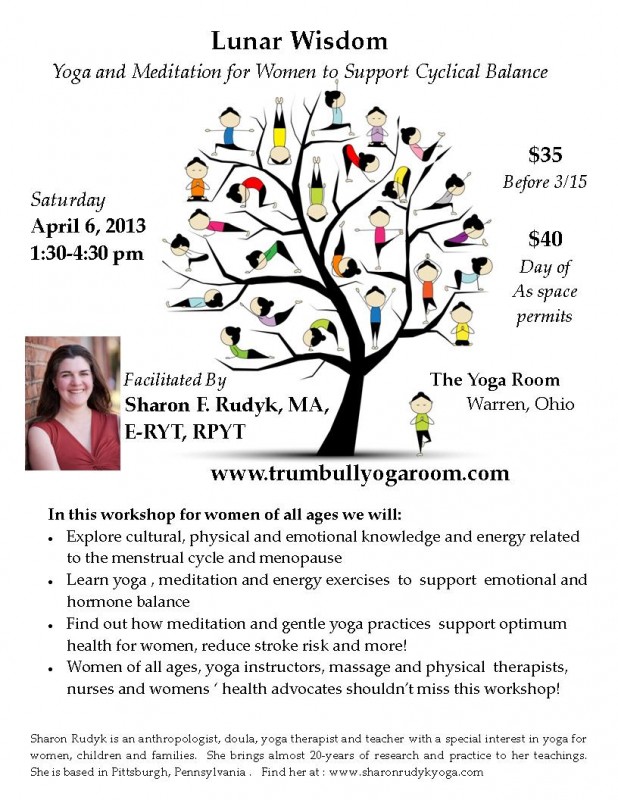
I am so delighted and honored to have been invited by The Yoga Room in Warren, Ohio to facilitate a workshop on the lunar cycle and womens’ health.

Lunar Wisdom 4.6

In this workshop for women we will explore various cultural, physical and emotional beliefs around transitions in the menstrual cycle. For this experience, we will focus on the moon cycle that brings women through a variety of energetic wisdom cycles that are separate from the menstrual cycle.  Through visualization and meditation, we will learn a specific technique to tune into this energetic moon cycle and to use this cycle to support our creativity, decision making and intuitive trust.  Next, we will explore yoga poses, energy practices and aromatherapy that supports hormone balance, cardiovascular and reproductive organ health and sexual energy through pre-menopause and menopause.  Although this session will be about the cessation of menstruation, the techniques and yoga tools provided will be useful to women in all phases of menstrual cycle and experience. Participants will explore the anatomy of menstruation and the cessation of menstruation from the perspective of embodied anatomy.  This awareness and knowledge is empowering for women of all ages and is especially helpful to yoga instructors, physical therapists and massage therapists who wish to use an alternative understanding of menstruation in order to support the inner healing wisdom of their female clients and students.  Finally, participants will be introduced to a variety of meditation techniques and gentle movements that can be used to improve the mind-body connection.  This enhanced connection decreases risk of stroke and other cardiac events, enhances gray matter and improves emotional regulation by the amygdala.