Tag: Tibetan Buddhism

Tibetan Yoga Classes

Tibetan Yoga on Wednesday Mornings 10:00 am

In my personal practice of yoga, in the past five-years, I have started to bring more and more of my meditation into my yoga and more of my yoga into my meditation.  Essentially, it is now one practice.  This is possible because the type of somatic meditation that I practice (somatic meaning “of the body”) is rooted in Vajrayana Buddhism.  This is one of the major schools of Buddhist practice and thought that is based on the idea that we all already possess Buddha-nature in ourselves and that enlightenment is just the recognition of our true nature.  The practice has more to do with learning techniques that access much more than the physical body and bring us into a state of open awareness to things as they are.  It is in this “space” where all potential and opportunity exists.  We don’t need to make anything, improve on anything, get more flexible or strong or change anything.  Rather, we use our tools of somatic awareness to enter into an open space.  It’s the difference between being shown a seat at a table where there are bins of colored markers, feathers, glitter, paints and multicolored paper and being shown a seat at a table where you see some used lined paper and a worn down pencil.  It isn’t that you couldn’t make something happen with that lined paper and pencil, but when you get seated there, you have to really work to think of the possibilities.  At the other table, you see all those supplies and your energy is uplifted and you feel like there are endless things you could create.  These tantric practices are about entering a space that feels like you just got a seat at the table with all the colorful art supplies.

I don’t know, but I guess it is possible that you might become more flexible over time or that you might get stronger or lose weight.  But, really, what kind of “goals” are these in the face of the idea that you could live every moment of your life like you just won the creative supply lottery?  No matter how much yoga you do, you are going to get older (We hope! Right?), sometimes you may get sick or be tired or get an injury or disease.  What I am realizing more and more is that you can’t get better at yoga or meditation, but you can find your way into this delicious state of awareness and find yourself able to stay there for longer and longer periods of time.  It isn’t some fantasy location or a vacation place that you have to, eventually, leave.  The more you practice, the more life feels like a seat at the table of infinite glitter and less like you are stuck trying to make magic with a worn down pencil.  We use the body, but it isn’t ABOUT the body.

This being said, the movements and physical exercises of Tibetan yogas are very much like the asana you are already familiar with from Hatha or Indian yoga traditions.  I start these classes with a very simple energy sequence that you can do at any time if you feel like you need to get your energy moving in the right direction. Then, we set an intention of metta (compassion, or loving-kindness).  Whatever your own intention is for making your practice a priority, that is up to you.  But, as we join together, we recognize that our practice is for something outside of ourselves.  We practice to improve the quality of life for all living beings.  Again, maybe you will feel better in your own body after practice, but we don’t practice just for this purpose.  Then, we take nine cleansing breaths to clear the major energy channels of “drip” (low energy or blocks).  Starting out with free flowing energy and clear of any drip, we loosen the joints, practice some asana (physical postures), use techniques such as sound, visualization and hand postures to build our life-force and then we meditate and relax.  While some of this may seem familiar, the effect is profound.  I personally feel liberated, grounded, and inspired after I use these practices.  I love this open feeling-place and the fact that I can access it no matter what is going on in my life or whether I have an injury or physical challenge to practice.  When I mostly practiced flow-style yoga, if I had a hurt wrist or ankle, I felt like I couldn’t “do my whole practice” or practice for “real” until the injury healed and I could go back to it.  Now, I feel like I can do my whole practice and get the full benefit even if I have to do the whole thing lying down.

I’m happy to share these techniques as I understand and practice them and hope that you will use them to enhance your own home practice.  No matter what other kinds of yoga you like to practice, learning these simple techniques can add more options to your tool box for whenever you need to create space around a problem or concern or just find a sweet spot to relax that you know is yours to enter into whenever you like.
Wednesday mornings at Samira Yoga from 10:00-11:15 am.  I’m starting with a six-week series (February 1-March 8, 2017) and we will see if there is a group that would like to continue.  

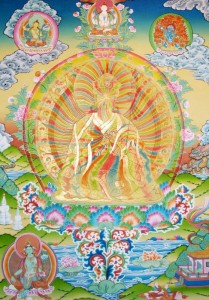
Practice Notes: Rainbow Body

rainbow bodyEach week, I teach a mindful yoga class on Tuesday nights at Mookshi Wellness Center.  Recently, I have adapted a new preparation technique for teaching my classes and find the foundation theme for my class through daily prayer and meditation.  I have always been guided to teach from the wisdom of my practice as I was encouraged to do so by my compassionate and insightful teacher and mentor, Jill Satterfield.  But, for the past two-months I have been randomly choosing a sutra from Lorin Roche’s beautiful translation and commentary of the Vijnana Bhairava Tantra, The Radiance Sutras, and allowing the message of that particular sutra guide my choice of breathing, asana and visualization practices.

This past spring I took a truly amazing distance learning course with Janet Conner called “Soul Vows” (also the title of her newest book, which is phenomenal) and was able to do so through a generous full scholarship that she offered to me.  The truth is that I had a hard time with the course.  I still haven’t come up with my soul vows.  But, I had found her course through some research I was doing for my Radiant Heart course that I was in the process of creating and the soul vow discovery process required that I choose a spiritual book to accompany me on the work to nourish and keep it sacred.  The Radiance Sutras are “112 Gateways to the Yoga of Wonder and Delight” and while I couldn’t seem to identify my Soul Vows during the course, I kept thinking of the phrase “Choose Joy!” and these sutras and the commentary truly are about choosing joy regardless of circumstances.

This week, in preparation for class tomorrow night (if you are in Pittsburgh, please join us–it’s pretty much the most beautiful gathering of people I’ve ever been a part of, not competitive and you are warmly welcome), I randomly chose the 20th sutra and in the commentary, Roche suggests that we “sense all directions simultaneously” (Radiance Sutras, page 214):

Above me is endless space.
Below me is endless space.
Behind me is endless space.
To my left is space.
To my right is space.
Within me is endless space.

Roche suggests that “As the directions dissolve, so does your definition of yourself (214).”  When I read this I was drawn to Rose Taylor Goldfield’s instructive description of the Rainbow-like body in her book, “Training the Wisdom Body”.  She says, “The main point to remember about your body is that it is appearance-emptiness like a rainbow; it is purely the energy and play of luminosity-emptiness, like a body in a dream when you know you are dreaming.  Recall that your body is naturally light and luminous as you practice yoga movement.” (Taylor Goldfield, page 97)

The “Rainbow Body” in Dzogchen (an esoteric Tibetan Buddhism), refers to a level of realization.  This realization is when the separation between all living beings and phenomenon dissipates and all is one.  Taylor Goldfield instructs, “As you move your body, dissolve fixation on the duality of your own body here and the surrounding environment out there.  Melt into space.” (page 97)

In our practice this Tuesday night we will play with space and expand our inner and outer light for the benefit of all living beings.  Can’t wait!

REFERENCES

The Radiance Sutras: 112 Gateways to the Yoga of Wonder and Delight
Author: Lorin Roche

Training the Wisdom Body: Buddhist Yogic Exercise
Author: Rose Taylor Goldfield

Path to the Rainbow Body: Introduction to Yuthok Nyingthig
Author: Dr. Nida Chenagtsang

Soul Vows: Gathering the Presence of the Divine in You, Through You, and As You
Author: Janet Conner


Space in Hiding

This morning I was drawn to one of my favorite books that I have never actually finished.  This book is about a personal spiritual and geographical adventure, but also about pilgrimage and finding personal truth in something as slippery as space.  In The Heart of the World, Ian Baker introduces (at least, it was new to me!) the Tibetan Buddhist concept of beyul, or hidden lands.  The idea is that through spiritual practices and physical preparations, places on earth that were not immediately open to us, become places we can travel.  These mystical sanctuaries are “hidden” until they are revealed.

The implications are so significant, that I fear absolute failure in any attempt I might make to illuminate them through the written word.  But, if you need a mind bending and inspiring book to read this season as the leaves change color and life seems to cycle-down, I recommend this one.  Even if you don’t finish, it will change the way you think about space forever.

Posted by Sharon Rudyk, owner and director of YOGA MATRIKA, a community-based yoga studio in the city of Pittsburgh, Pennsylvania offering high quality yoga, meditation and creative movement classes for adults and children of all ages.